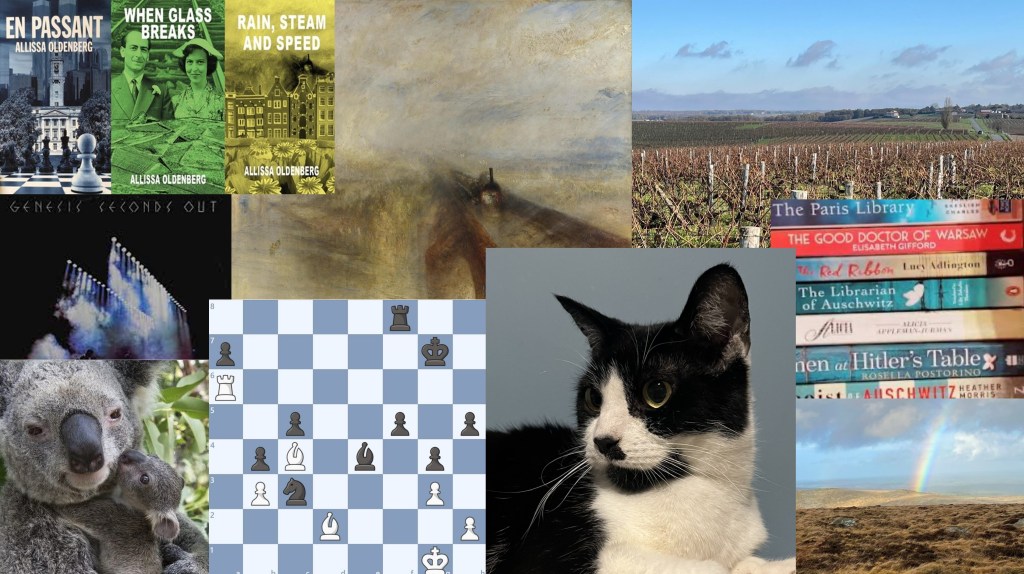
The decision to write
There are moments in any given year, two in 2025, when I wake up and decide I am going to write a novel. I will have been pondering the plot for several weeks as I walk my dog in the woods each morning before work.
During what I call normal time, outside of a full-time job, walking the aforementioned pooch, undertaking household chores, the entertainment my husband and I share most evenings (two games of chess and watching DVD’s or TV drama/crime series on download) followed by as many hours of sleep I can enjoy (which is never as many as desired or needed), there is the house in France to renovate, family and grandchildren to visit, fine art jigsaws to construct (usually evenings in France after DIY), and European weekend breaks to explore (maybe one a year). When the decision to write pushes its way to the front of my quotidian crowd of activity, those leisure opportunities vanish, and I resolve to carve out a creative recess, generally lasting one to two hours, each evening before my head hits the pillow. Mental reviewing, editing and developments accompany me on my dog walk, ready to be processed later in the day.
It is this creative method which shapes my narratives and writing style. I prefer chunks to chapters, usually one to two thousand words in length (sometimes a two-to-three-thousand-word chunk is necessary). As you might imagine from a chess player, my mind is continually contemplating the various threads and interactions which are woven together throughout the novel. The chunks toggle between these threads in my working memory, and it is my chess brain which corals them.
Two “extracurricular” activities I forgot to mention earlier are, firstly, my tendency to become side-tracked on the internet, pursuing some nugget of research, doubtless because a subject popped into my head during my daily dog walk, and secondly, that during the last couple of years I have taken several short online courses in subjects which whet my intellectual appetite and curiosity, including criminology and psychology. An aspect of psychology topics which I studied is how memory works. This included the working memory model of Baddeley & Hitch (1974) the levels of processing of Craik and Lockhart (1972), and the multi-store model of memory of Atkinson and Shiffrin (1968). One of the subjects I teach in my day job is adult education, as in preparing teachers and trainers for working in the education and skills sector, and I have long been fascinated by how so many learning theories are based on psychology models. It was “connectivism” which sparked my latest tangent.
Having ranted about AI in one of my previous “Snippets,” a plethora of posts and comments about the use of AI in creative writing appeared to have prompted the Meta algorithm to highlight these in my Facebook feed. This ignited a pyrotechnic display in brain, comparable to any New Year’s Eve offering. I started to research Large Language Models (for dummies), and whether anyone had written an academic article about AI and the short story by Borges (my literary hero) called “Funes the Memorious” (they had). I now have two metaphors bouncing around my cerebral hemispheres clamouring to become short stories. There’s already another novel in “The Helen Investigations” series rapping on the window of my creative soul. Looks like the decision to write is fast approaching. (I hope you have enjoyed this brief insight into my creative processes.)
Allissa Oldenberg 01/02/2026
Happy 2026 to all my readers and followers
A couple of weeks ago, I put up two snippets which reflected on 2025 through the metaphor of kaleidoscope eyes, one personal, the other more political. Globally, I look ahead at 2026 with a sense of trepidation. None of us knows the personal impact of global politics on our daily lives, although we always dare to hope that our personal aspirations might be reached.
With that in mind, my hopes for 2026 are: to write another novel (whether it’s another police procedural in “The Helen Investigations” series or Helen’s memoir remains to be seen); to persevere with queries and submissions; to maintain a presence on social media (new followers always welcome); to enjoy my grandchildren; to continue my bricolage in France; and to stay fit and healthy (although the new year began with a bout of Covid).
I have changed my “Snippets” feature photo to reflect, although not exclusively, the focus of my Facebook content for 2026, along with my likes and interests. I will continue to post daily humour; some feline fursomeness provided by Domino; cuddly cuteness in the form of koalas; the books I like to read and the movies and dramas I like to watch; not to mention the shameless self-promotion.
Hopefully, I will also put up regular snippets, remaining true to myself as always. I absolutely refuse to apologise for being political or philosophical. Life is to be lived, and far too often, the rich, the compassionless, the bellicose and the powerful, trample over any opportunity the powerless, the colonised, the peace lovers, and the poor of the world have to enjoy living.
Thank you to my base of faithful readers and followers. Welcome to those of you who decide my website, my posts and my books are for you. I wish you all a Happy 2026.
Allissa Oldenberg 10/01/2026
Kaleidoscope eyes (Part 1)
Reflecting on 2025 reminds me of the kaleidoscope I once played with as a child. There was an element of brinkmanship in how far you could rotate the tube before the pattern was rearranged irrevocably. Words like hypocrisy; inconsistency; denial; entitlement; and insanity spring to mind. It has always been about the geopolitics, but this year, far from a child’s toy, I fear the global brinkmanship has rearranged irrevocably the patterns of both politics and geography.
Closer to home, we have seen politics by media and social media manipulating representative democracy, which is unfortunate, given the kaleidoscope of disinformation and ignorance available in the echo-chambers of the populus. NHS dentistry is moribund, to which the large cavity in my molar bears witness. Meanwhile customer service is all but extinct, and as artificial unintelligence takes over, I just want to talk to a human about my issue. Apparently, we have four British Values: Democracy, Rule of Law, Respect and Tolerance, Individual Liberty. It often feels more like Anarchy, Rule of (tax) Loophole, Keyboard Warriors and Appeasement, and Individual Restrictions. I’d rather live here than in many other nations, but perhaps that is why I grieve the subtle erosion of the values I cherish.
John Lennon and Paul McCartney were not so far from the truth:
Picture yourself in a boat on a river
With tangerine trees and marmalade skies
Somebody calls you, you answer quite slowly
A girl with kaleidoscope eyes
Allissa Oldenberg 29/12/2025
Kaleidoscope eyes (Part 2)
The metaphor of a kaleidoscope plays out every year of our lives. Even in the most transient of our relationships, there is a fusion of everything that both individuals have ever experienced, and we are changed forever. You can enjoy those experiences or learn from them, and if you are a writer, you can use them as springboards.
There is much about my as-yet-unpublished crime series, “The Helen Investigations,” which could be catalogued as auto-fiction. Get to know Helen, and you get to know me. Maybe not in the police procedural plotting, but in Helen’s character, her interests, her outlook on life.
I started 2025 with the intention of writing a novel. Doggedly attempting to compose around a thousand words a day, more at the weekend if possible, I accomplished a third book in “The Helen Investigations” series. Hardly had I completed the editing, when I received a message from a long-term friend, drawing my attention to a fascinating discovery at my former secondary school. This became the catalyst for a fourth book. At present, I am collecting rejection emails.
My other intention (I won’t call it a resolution) was to broaden my social media reach. Allissa Oldenberg is now active on Facebook, Instagram, TikTok, Bluesky and X. It has been fun putting together weekly reels, which, when not an excuse for shameless self-promotion, have offered a fleeting glimpse into my love of nature.
2025 included some hugely significant personal happenings for me. Already the besotted grandmother to a three-year-old, I gained two additional grandchildren (one from each of my offspring). It is not simply part of the job description to take myriad photos. Grandparents (and parents) are desperate not to miss a single expression or event, before the developmental kaleidoscope rotates and we discover the joyous reassurance of the ever-changing milestones. We desire all that is healthy for our grandchildren, and like their parents, we watch from the wings as their social circles expand, and they navigate the complexities of community and society for themselves.
If my late father thought rotating the kaleidoscope of his own past would commit to oblivion the secrets he kept and the lies he told, he had clearly not anticipated the tenacity of his own daughter. There are still some years unaccounted for, but I now have in my possession a photograph of my fourteen-year-old father with his father, mother and two older sisters (there would be a younger brother, too). I know his real name, and where he was born, and none of it bears any resemblance to the fragments of disinformation he reluctantly shared with us.
John Lennon and Paul McCartney also went on to write:
Picture yourself on a train in a station
With plasticine porters with looking glass ties
Suddenly someone is there at the turnstile
The girl with kaleidoscope eyes
Allissa Oldenberg 29/12/2025
The opium of the people
Karl Marx was definitely onto something. Unfortunately, he is often misquoted, or quoted out of context, and nowhere more so than probably his most famous words, “Religion is the opium of the people.”
To return those words to a wider context, whilst acknowledging that there are several ever-widening contexts of paragraph, polemical discourse, historical circumstances etc., I shall include more of the text: “Religious suffering is, at one and the same time, the expression of real suffering and protest against real suffering. Religion is the sigh of the oppressed creature, the heart of a heartless world, and the soul of soulless conditions. It is the opium of the people. The abolition of religion as the illusory happiness of the people is the demand for their real happiness. To call on them to give up their illusions about their condition is to call on them to give up a condition that requires illusions.”
Now, I am mentioning this for two reasons. Firstly, I am continually struck by the potential of religion to be misused. For example, there is the ability of certain Christian perspectives in the USA to justify the unjustifiable social inequalities sanctioned by the resent administration. Or another example, closer to home, might be the use of the St George’s flag by those who seek to open the door to fascism, but close the door to migrants, claiming this United Kingdom is a Christian country.
The liberation theologians recognised that a more just interpretation of the Bible was to challenge the oppression both within the church, and those in society who used the church to justify the oppression of the poor. More problematically, a country cannot be Christian, because at the root of the Christian faith is a relationship with the Messiah who came to announce and bring in a heavenly kingdom. Wherever Christianity becomes a religion, it opens itself up to the criticism which Marx articulated.
In our post-modern, western society, where spirituality is increasingly embraced over Christianity, the individual is encouraged to look for personal peace and wellbeing through a smorgasbord of practices, some borrowed from eastern religions or from indigenous rituals, including mindfulness, relaxation techniques, dietary habits, multi-sensory experiences, and more. These too, it could be argued, are “the opium of the people.”
Secondly, whilst religion may be losing traction in the United Kingdom, we increasingly hear what appears to be a societal mantra “resilience, resilience, resilience” in schools and workplaces, especially the public sector, who also like to train champions of mental health and well-being. I recently attended such. Am I alone in seeing the parallels with Marx?
All the while we promote resilience or connected conversations around mental health and wellbeing, we are reinforcing the technical class, the policymakers, the organisational structures in which many individuals, the majority of whom are at the lower end of the pay structure, struggle. I have an inkling that training individuals in resilience and mental health support (and don’t misunderstand me here, because I am not against anything that saves lives) diverts attention from, even dulls our senses to, the often short-sighted and (politically) self-interested decisions made by those in charge, and stops people challenging those decisions. Have resilience and mental wellbeing strategies become the opium of the people?
The criticism of corporate wellbeing strategies (or individual survival mechanisms in wider society) as the illusory happiness of the people is the demand for their real happiness. To call on them to give up their illusions about resilience and mental wellbeing strategies is to call on them to challenge a condition that requires resilience and mental wellbeing strategies. Karl Marx was definitely onto something which has enduring relevance today.
Allissa Oldenberg 23/11/2025
If you notice this notice
Does anyone admit to writing in friends’ autograph books, back in the day (the sixties and early seventies – ssssshhh)? A favourite epigraph was as follows: If you notice this notice, you will notice that this notice is not worth noticing.
I just deleted twenty emails from my junk folder. They were all from individuals who wanted to promote my novels or improve my website for me. (At least they were diverted to spam.)
Another unwanted intrusion that I always delete is the email which inevitably follows a recent purchase asking if I would like to review the product. I would not like to, no, really, no matter how many times you prompt me.
I did not renew my warranty on a washing machine, figuring that I would spend almost as much in insurance over the years as buying a new one, and I believe I have received six letters, enquiring if I had considered the matter. I did consider the matter. I just came to the opposite conclusion to the company.
Even when we think we have unsubscribed from an (automatically subscribed when we made the purchase) email, the company still has one more ace up their sleeve. Out of nowhere appears the “Please update your communications preferences” notification email. Did my unsubscribing not indicate my preferences?
And then there is my Facebook newsfeed. The algorithm strikes again. Actually, credit where credit is due. After my umpteenth notification of a “technical issue” – manifesting as the continual appearance of an indelible link to suggested pages, every time I clicked on my own page – the only way it seems possible to contact the social media giant – the problem went away. However, the algorithm still seems to behave like a defiant pre-schooler, push, push, pushing the boundaries, in the hope that I cave.
Just because I post pictures of my cat, does not mean I want my newsfeed to be peppered with everyone else’s cats, especially not images of their dead cats. The cats (writers’ pages) I follow are welcome, of course. My cat on my page is for people who follow me. I would not expect, or wish for, posts about my cat to be dropped into anyone else’s newsfeed, unsolicited.
All of the above examples are symptomatic of a ubiquitous intrusion drift (like mission drift, only towards us) which inhabits social space. We have, it appears, come full circle.
Even further back in the day (long before I was a twinkle in my parents’ eyes), people living on the same street might appear at a neighbour’s door without invitation. Point of clarity – maybe only in poor communities (you still needed an invitation, or to leave a speculative calling card if you were middle class and above). These days, we hardly dare knock on someone’s door, without an invitation, not even our friends. Some dare to knock – the ones who are selling something, canvassing or campaigning, hence the “No cold callers” stickers becoming increasingly prevalent.
And yet, according to the mores of the virtual neighbourhood, such invasions of personal space are normal. But this invasion of virtual, personal space is detrimental to the very community it thinks it is building. The moment you follow someone, they disappear from your newsfeed, only to be replaced by the profile of someone you have never even heard of. I would much prefer my favourites to appear in my newsfeed, because they are part of my community.
I am not influenced by influencers. I do not buckle under the weight of marketing. I prefer not to feed the insatiable appetite of consumer society. I make my own choices. And, I notice the unnoticed, the underdog, the voiceless, the unassuming.
If you notice this notice, you will notice that I do not believe your increasingly manipulative, market driven tactics to be worth noticing.
Allissa Oldenberg 11/11/2025
Service with a smile
I have grown weary of every company I seem to deal with online immediately sending a feedback request. Either the service was what it should be, in which case, why highlight it, or it wasn’t, and I don’t think that’s what they want to hear.
The county council shouts about itself in a newsletter. What is so newsworthy about a council providing good value for money to taxpayers by doing its job properly. I’m sure going over and above would receive recognition.
I recently experienced a difficult time with three large companies who all failed to provide a satisfactory standard of customer service. With two of them (a mobile phone provider and a courier) it was a case of, “It’s not our responsibility, contact the seller,” and “It’s not our responsibility, contact the courier.” The third company, an electrical and electronics retailer, could not have provided better customer service before I bought my vacuum cleaner, but when I went to report it wasn’t working, there was not even a customer services counter in the store. I made the assistant call the helpline, so his time was tied up for twenty minutes while I waited.
Silver service is often lack-lustre, and don’t get me started on the local dental practice!
Public service is meant to serve the public. The Civil Service (and government) is meant to serve civil society. The whole point of a service is to serve, but the idea of servanthood seems woefully lacking. Of course, there are many individuals in retail and in politics, in the NHS and in public bodies, who go above and beyond on a daily basis, but society at large appears to be experiencing an unprecedented mission drift in customer service.
So, what does customer service have to do with writing? Where does the publishing industry stand? It feels like the further away from the big publishing houses you look, the greater the customer service, because our sales and reputations depend on it. The challenge for writers is that reviews boost sales which boost reviews which boost more sales, all the while the traditional publishing industry seems entirely geared up to self-perpetuating it’s safe bets. “We just can’t take the risk!”
Writers sit somewhere on a spectrum between writing for an adoring public at one extreme to complete egotism at the other. If you don’t like a book you don’t have to finish it. I am not sure I write for readers as a homogenous market. I just believe there are some individuals out there who will appreciate my craft. Personally, I generally try to finish a book, if only out of respect. I believe there are only three books I have not persevered with (The Lord of the Rings, where I twice got stuck around page one hundred, but loved the films; Shuggie Bain, which I simply found impenetrable; and Kafka’s The Castle, which was all a very long time ago and I have forgotten why). There were two other novels which I started and then simply ran out of space and time to finish, but I’m sure I will revisit both, one day. These days, I rarely read as a customer, but as a fellow writer, trying to demonstrate solidarity.
I had to smile a few months ago when someone posted about a poor review on a large online retailer website which shall remain nameless. The review was poor, not because of the content of the novel, but because the customer service provided by the retailer was so poor. How damaging to the writer who entrusted their sales to the retailer.
One of the great things about writing is that you can create worlds where customers are treated well, and where poor customer service can be punished. And if you’re Charles Dickens, you can even reform the person from providing poor customer service to providing the best. “Bah humbug,” I hear you declare, or service with a smile!
Allissa Oldenberg 11/10/2025
Is it true?
There is nonfiction and there is fiction. There is autobiography and there is, well, memoir. I am always slightly disconcerted when someone asks of a novel, “Is it true?” Historical fiction is not a documentary. Memoir is written through a lens of subjective memory, where what matters is the emotional reality, and where it is acceptable to give an interpretation of the facts. The litigious age in which we live is both concerned that truth should not overspill into libel, whilst at the same time demanding total veracity amongst plot, characters and narrative action.
Wherever we look, truth is under assault, whether it’s fake news, alternative reality, conspiracy theory or straightforward lies, which in the context of social media, are able to create parameters in which those lies may appear convincingly true. We want the truth and yet we do not want the truth.
We tell many white lies throughout our lives, usually to protect our own reputation or that of others, not realising that the telling of those white lies tarnishes our reputation. In memoir, how much does it really matter, that certain individuals remember the narrated reality differently?
As a society, I think we have become less interested in truth and more interested in gossip, or rather, we only want to know those aspects of truth with which, like Puck in A Midsummer Night’s Dream, we can make mischief. The Radio 4 Today programme presenter probes repetitively for a scoop. The tennis journalist wants to know if Emma and Carlitos are dating. The opposition want to uncover every skeleton in every cupboard, if only to score points. We feel an entitlement to pry. It must be in the public interest if it titivates our imaginations.
When a writer creates, they are using experiences, memories, events, relationships and situations, anything and everything, as a prompt or springboard for their writing. Is it true? It happened, but did it happen to them or to someone else? Did it happen to them, but the names have been changed? Did they research it, or did they live the experience? It does not matter one iota, as long as we are carried along by the action and emotions. So why are so many people getting very irate about a certain salty coastal walk?
Sometimes, fiction helps us to face things that happened which we wish had not happened. At other times, fiction allows us to make up the wildest and most extravagant dreams that we wish could come true. Whilst the situations may be imaginary, the emotions are vividly true.
Time, I feel, would be much more wisely spent, researching and critiquing the damaging untruths that circulate on the internet. Lies which are promoted as truth are far more damaging than the stories we make up about ourselves. Mr Putin seems to have convinced most of Russia that the lies he tells about Ukraine are the true version of history. The conspiracy theories which motivate the likes of Vance and Kennedy are a pernicious and manipulative fantasy. Freedom of speech is not a licence to pedal an alternative reality.
The age of reality TV has turned the lives of both celebrities and ordinary people into entertainment. In some cases, it has turned ordinary people into celebrities. What concerns me is that people are more entertained by reality TV than by fiction. And that, I believe, is the source of the troubling enquiry. Is this novel true? People are looking for reality fiction, and that is a contradiction in terms, but one with which we seem to have become uncomfortably comfortable.
Allissa Oldenberg 05/09/2025
The way of the ostrich
When my first grandchild was two, I heard a book recommendation on Radio 4, so I decided to buy him Quick Quack Quentin by Kes Gray and Jim Field. Of course, as two-year-old, he was unlikely to understand what was going on but, as we all know, reading to a small child is sowing seeds for the future, as well as an enjoyable, relationship-strengthening snuggle-time. I could hardly finish reading the story due to the tears of laughter streaming down my face. Like Disney-Pixar-Dreamworks films, the irony is lost on a small child.
As a writer with a presence on social media, I read many posts on Facebook about reading. I am struck by the two poles: those who read to understand reality and those who read to escape reality. And there is much about the present reality it would be good to escape. We cannot simply bury our heads in the sand, though.
I would be interested to identify research about the relationship between reading and social conscious, between reading and social activism. No one, we are told, likes an author to push their ideas down our throats, a little like my dog receives her worming tablet when we return to the UK after our time in France. Nevertheless, characters are built on a degree of verisimilitude, and we can love them or loathe them depending on their actions and motives (if indeed, their inner world is revealed to us).
There is a beguiling, and at times frustrating, difference between fiction and reality when it comes to characters who displease us. In fiction, bullies usually get their comeuppance. Sadly, the likes of Trump, Putin and Netanyahu are unlikely to receive theirs, or if they do, it will be long after too many lives have been ruined or taken. Is there anything we can do to influence the outcome? Beyond signing petitions and writing to deaf politicians, potentially not. So, we reach for a novel and bury our heads in the sand.
I believe it was Paulo Freire who once articulated that to be neutral is to side with the powerful. Maybe geopolitics is best resolved by diplomacy, but we do not have to look too far back in history to see the environment that appeasement can create.
I you should choose to read my novel, En Passant, you will see that my fictional author Helen takes a stand, my characters take a stand, and usually, the stand I value as a writer is the one which most prevails. The same can be said of When Glass Breaks or Rain, Steam and Speed. You can choose not to read my novels because you disagree, or because you prefer to read as an escape from reality, and that is entirely your prerogative.
Even children’s books generally tend to value kindness over cruelty and inclusion over bigotry, and yet we very rarely hear the same cry that the author’s moral viewpoint should be withheld. At what point and at what age do we decide when a course of action should cease to be promoted? Do we teach children to read so that as adults, we can understand the subtle relationship between patrimonialism and autocracy, or so that we can bury our heads in the sand?
There does indeed come a point, and in the UK, our government has just decided that sixteen-year-olds are capable of political choice, when we have to stop being neutral. I am genuinely concerned by the direction of global politics towards self-centredness, unkindness, mercilessness and autocracy. Conversely, and also troublingly, it is becoming increasingly difficult to distinguish in certain contexts between democracy and anarchy. Sadly, so much about politics today is based on a complete lack of reading.
I write because I enjoy being creative with words and ideas, but I also write in order not to take the way of the ostrich.
Allissa Oldenberg 02/08/2025
Memory
This morning on my dog walk I could not get the Andrew Lloyd-Webber song “Memory” out of my head. When I was back indoors and all dried off, I listened to Barbara Streisand singing the song. In a short snap of time I found myself on the verge of tears, partly because I could not stop thinking why anyone would abandon a cat, partly because of Streisand’s haunting voice, partly for the cats I’ve lost, partly because of homelessness and the homeless people I used to work with, partly because of who first took me to see Cats, and partly because my late mother would have known every musical in a pub quiz. Memory does that to us.
I recently drove over two hundred miles to a school reunion. I was last in that place forty-four years ago. That I should end up living ten miles down the road from my secondary-school best friend is a strange quirk of fate, so we made the journey together, and met up with a third member of our little card-playing group (sadly the fourth was unable to attend). We were permitted to wander around the school, entering some of the classrooms, the main hall, the gym, the ‘T’ block, so named because it was meant to be temporary, more than forty-nine years ago when we first started. Our conversation was fairly representative of most conversations at a reunion from so long ago. We misremember things and have to cross-check them with others who were there. We build up a more composite picture by sharing those memories which are still lucid to us.
On my long car journey, in order to reach the destination, I had to rely on memory. There’s the muscle memory of driving. Can you remember how you once thought you would never be able to co-ordinate handbrake, clutch and accelerator, and yet now it’s second nature? I had to remember to turn off at Junction 5 as I continue on that stretch of motorway six or seven times a year en route to France. I was remembering the journey, marking off those sections in my head, monitoring the time, choosing when and where to stop for a break. I had to remember which sections of motorway I did not want to get stuck in the wrong lane. With the growing number of speed cameras, I had to remember to stick to the speed limit. Most poignantly, I remembered that the last time I turned off at Junction 5 was to rendezvous, unannounced, with my mother in accident and emergency, which sparked a later memory of her absolutely forbidding me from going to the hospital when she experienced her fatal pulmonary embolism, knowing how my memories would later torture me if I had seen her passing.
Thinking about our collective memory in society, I do worry about the way our past history is being re-written, and our present history is being edited out. With all the disinformation and conspiracy theories running rife, it’s hard to find a place for the genuine writing of collective memory. It is said that history is written by the victors, but in the last few decades, the vanquished, the marginalised and the oppressed have been able to write their legitimate alternative perspectives on our collective memory. Now it seems that even in societies founded on democracy, we find that paternalism and authoritarianism are trying to sensor our collective memory and write history through their own somewhat narrow perspective.
I’m a writer, and I need my memory to write. First and foremost, my fictional author-narrator, Helen, is an extension of myself, and whilst much of the content of my novels is fiction, those references to factual settings and occurrences need to be both plausible and logical (even though references to people and places may be entirely coincidental). I misremembered something in my last published novel, in spite of endless research. Secondly, I am not a methodical writer. I do not plan my novels meticulously, but rather loosely. For me, the creativity and excitement come from the characters and situations taking over. My dog walks are often the arena where I play scenes over in my mind, later committing them to the first electronic draft. It is imperative to remember the details, the cues, the prompts, and to follow through with these at a later point in the novel. It’s because my memory is eclectic that I send myself emails, so I don’t forget.
All of this reminds me to explain why I write. I wanted to write Rain, Steam and Speed for my brother, in his memory. I wanted to write When Glass Breaks to honour the complex father who I never really knew the truth about. Anything beyond my living memory or outside of my personal experience I have to research, but as mentioned above, I also check my own memories through research as well. Names may change, and plotlines may be entirely fictional, but from the point of view of character, they are as I remember them, warts and all. The same applies to Helen. If you get to know Helen as a character, you get to know me, even if only half of the content is factual (or verisimilitude) and the other half imagined. I want my children and grandchildren to read my novels (and not feel embarrassed about some of the romantic scenes) and perhaps understand who I am, what motivates me, and the things that have influenced my life. Perhaps they might even be proud of me for writing so many novels (yes, there’s lots more as yet unpublished).
We also need memory to read. We need to remember what went before in the narrative, but we can also only read as we remember everything that we have ever read before. That is how we bring meaning to the text. Even when we read to escape those things we’d rather forget, we cannot escape the need for memory in reading.
Without memory, we don’t even know who we are in and of ourselves. But will we remember only the bad stuff or will we edit out everything that doesn’t suit us? Will we be honest about the memories we have of ourselves? Will we allow our memory to be kind to us? The question is where are we going to cross-check the things about ourselves that we misremember? In many senses, we are what we remember about ourselves and what others remember about us. We are our memory, and yet we are so much more than our memory. Maybe that’s why the song, “Memory,” is so haunting.
Allissa Oldenberg 06/07/2025
The Helen Investigations
“The Helen Investigations” series now comprises three novels. These are police procedurals with a difference.
All my novels relate to a fictional writer, Helen. These crime novels are no different.
Helen Linton-House was a bright and imaginative child who has developed into a creative and intellectually astute student. She is an introvert with a strong intuition and increasingly sharp observational and analytical skills.
I have placed these novels in a series called “The Helen Investigations” because Helen investigates crimes, but she also investigates what it means to be herself and what she wants to do with her life. This means that the novels are as much about Helen as they are about the police solving the crimes.
Each is set during a year in Helen’s life (when she is eight, seventeen and twenty-two). Her involvement with the police is appropriate to her age and cognitive development. She is exploring her sense of identity (milestones, rites of passage, love, independence, etc.) when the various crimes capture her imagination and interrupt her life.
Although Detective Inspectors in each situation suggest she might like to join the police force, it is possible that Helen missed her vocation as a detective. Instead, she has become a successful writer.
In all my novels, the reader is introduced to examples from Helen’s creative journey, with short stories and poetry that she has written throughout her life. This is part of what makes “The Helen Investigations” police procedurals plus!
The novels narrate major crimes against women, and understanding what is happening is part of Helen investigating her place in the world.
I will shortly begin querying agents and submitting all three of “The Helen Investigations” series to publishers.
Allissa Oldenberg 26/05/2025
Fixing potholes: just another fairytale
The government recently announced a new pot of funding to help fix the pothole crisis. Is this just another fairytale, I ask myself.
I live in Devon, which of itself, is a bit of a fairytale location. With Dartmoor and Exmoor, sandy beaches and rocky cliffs, woodlands of beech and oak, and acres of farmland, Devon is a county of great beauty and wide-open spaces. To cover such great distances the county boasts the largest network of roads in the UK.
If there were a Pothole Premiership table, Devon would be the equivalent of Liverpool FC.
My day-job requires a lot of driving of me. I seem to spend half my life negotiating potholes. There’s something mildly intrepid about getting in the car every day and driving to try and avoid potholes. I have not been completely successful, as 2024 saw me purchasing one new front suspension coil, four new tyres and having to replace the windscreen. Nor is it always possible to avoid the potholes, especially when it’s dark, wet, or a vehicle is approaching in the opposite direction.
You might think I would welcome the government’s funding for potholes, and the attendant sanctions against councils who fail. However, fixing potholes in Devon seems to be particularly ineffective.
Last year, some bright spark decided to cover a well-used lane in chippings. The method is meant to be cheap and easy – put down a bed of molten tar and cover it with the chippings (a term which relates to windscreens well). There’s no need to pass a roller over it, as the traffic will wear it down. The first problem here was that it only got worn down in twin ruts. The second problem was the weather (ooooh – an excuse). A brief period of hot sun melted the tar and any car driving along it ended up with tyres that resembled the chocolate-mint-chip coating on a Magnum.
Many of the A-roads in North Devon and Torridge get fixed in sections. It seems that there is no properly-sealed join between the two sides of a road, so with Devon’s inclement weather, a few months later, water has run off the fields and trickled into the join and begun to wash it away.
There is also a problem with the way potholes are categorised. Devon County Council policy states that only potholes (with steep edges) that are 40mm deep will be fixed. The chipping top-dressing is only 35mm deep, and it is this which mostly disappears creating the potholes. There is no obligation to fix them, because they are not deep enough (by half a centimetre).
As I have driven over several supposedly maintained roads, sporting new surface-dressing which consists of those well-loved chippings, I am struck by how Highways managers cannot ever have been read the Hans Christian Andersen fairytale about the princess and the pea.
A queen had placed a pea on the bed frame and piled twenty mattresses and quilts on top, in order to test if the woman who had knocked on the door looking all bedraggled from the rain, was in fact a real princess, as only a real princess would be sensitive enough to feel the pea. To be honest, I remember a slightly different version, where the princess complained about how uncomfortable the bed was, and the servants kept piling mattresses on top, rather than removing the pea.
The way Devon County Council fixes potholes is like this fairytale, except it’s not a pea but a pothole. They cover the potholes in layers of chippings. Each layer is intended to level out the potholes, but all that happens is the chippings recede into the bottom of the potholes, and in time, the profile of the original potholes is redefined.
We need to remove the pea, in other words, properly fill the potholes before covering them with chippings. Otherwise fixing potholes will only ever be just another fairytale.
Allissa Oldenberg 29/03/2025
Accelerate Action
Today is International Women’s Day.
I have never really been a feminist. I just grew up making choices that weren’t influenced by gender stereotypes. That said, every so often, gender would turn round and slap me in the face with an uprooted cactus. Like the time I couldn’t play for the boys’ football team at school, even though I spent my breaktimes kicking a ball about with the boys and was one of the best players (yes, I am that old that there was no girls’ team). My praise goes out to all the women who have fought to make winning the women’s Euros a reality.
Many years later, when I was training lads, who were at risk of exclusion, in horticulture and landscaping skills, I would lead by example. One group of young men were particularly difficult, refusing to join me in wheeling barrowloads of bricks from one side of the allotment to the other, and when I challenged them, one lad threw down the insult, “You’re more of a man than I am.”
Across the globe, being a woman means many things to many different women. Last year I found myself teaching English to a group of Afghan women refugees. My heart aches for the situation their countrywomen face under the Taliban. Listening to Radio 4 in the car a few days ago, I heard the presenter critiquing Megan Markle’s new TV show, debating with a colleague if she was contradicting her previous stance regarding trad wives. Far too many women in developing countries are still dying in childbirth, and some have no choice but to succumb to one pregnancy after another.
I am deeply concerned about the rise of misogyny that we find both on social media and out there in the world. That the Tate brothers have been allowed to leave Romania and travel to the US is food for thought, although it surprises me little, given the new politics we are seeing across the Atlantic under the Trump administration. I’m not even going to comment on the rise of the incel.
Education has always been the pathway to empowerment and freedom for women. The challenge is for how schools and youth clubs, families and communities, can support young women to steer a path through disinformation and hatred. But I can’t help thinking, sometimes it is we women, especially several female influencers, who have bought into a certain way of being a woman which leaves so many females vulnerable to exploitation and manipulation.
If you are a woman, you are enough, just as you are. You don’t need to fall for the multi-billion-pound myth that the fashion and beauty industries espouse. The real you is beautiful, without an artificial layer of make-up. The human race has survived for thousands of years without dressing in a certain way.
I couldn’t sleep last night, and as I scrolled through Facebook, a video reel appeared in my newsfeed where a male hairdresser was styling the hair of girls who can’t have been older than between eight and twelve. These girls were wearing full make-up and had learnt to move their heads in the coquettish manner of supermodels. I baulked at this. Whatever happened to childhood, and who is it that is influencing these girls to the extent that they feel it necessary to adopt such forms?
Education is not the same as influencers, although for education to be successful, it needs to influence its participants. Of course, every young woman has the right to chose whether to be influenced or not, but surely some guidance is needed, unless women are to be absorbed into the lie which continues to legitimise and give permission to the widespread sexual objectification of our female bodies.
The 2025 theme for International Women’s Day is “Accelerate Action” and action was never more urgent. This Snippet is me taking action. My crime trilogy, of which the third, my WIP, is now approaching halfway, highlights different types of crimes against women. That is me taking action.
That I went to university and can vote; that I had two healthy pregnancies resulting in two safe deliveries; that I am the breadwinner in this household; that I could choose what path I walked down and trained for; and that I can drive, go to the local pub or teach, are all privileges and gifts that cause me to acknowledge those women who went before me and on whose shoulders I stand. Today is International Women’s Day and I honour my sisters, I recognise their struggle, and I celebrate them.
Allissa Oldenberg 08/03/2025
Life is not fair
Life is not fair. Some people are born into wealth and privilege, others to poverty and exploitation. Of course, we all make choices, but sometimes we are not free to choose, and other times our choice for freedom goes unheard.
I believe one of the more famous quotes from Bill Gates, when giving motivational speeches to young people, is that ‘Life is not fair.‘
I used to think ‘compassion fatigue’ was what you experienced when there was more tragedy and suffering in the world than your capacity for empathy. Now I believe that ‘compassion fatigue’ is what I feel in the face of an increasing lack of compassion and justice in the world.
I grew up in poverty. My father had a chronic illness and my mother nursed him (having giving up nursing, as was necessitated by the profession, when my older brother was born). He won a scholarship to a local private school (the challenges of social mobility is another whole story). I went to comprehensive and grammar schools. He got into drugs, and squatting, and dropped out of university (before disappearing from our lives – the springboard for my novel “Rain, Steam and Speed). I graduated from university (not Oxbridge, although that was what my parents hoped for me, not that I would have fitted in).
I was sporty, but also a little pudgy round the edges – it’s what comes from eating cheese on toast and chips or home-made jam tart and custard (to fill you up). So, one of the memories I have, and have never been able to reconcile, is something my mother once said in response the deputy head teacher at the grammar school (a bit of an ogre that you stood up to at your peril) when she insisted that I should be benefitting from free school meals. “Why vote conservative,” remarked my mother, “and then scrounge off the government?”
‘Scrounge’ is an emotive word, packed with class prejudice and entitlement. How many privileged individuals achieved their status, position and wealth through hand-outs from family and connections?
Now, it may well be that my political perspective was moulded, during my time at university, by Marx and Weber and Althusser. It is also shaped by my ability, compulsion even, to critique any form of power. And not just power, but also the self-interest in politics, especially as observed during recent conservative governments. Incidentally, my characters often share this perspective.
I know that this ‘Snippet’ could well be regarded as controversial, and upset many followers or potential readers, but I feel compelled to make some observations.
We live in a society that is the consequence of the ideology and practice of advanced capitalism. On a global scale, we cannot ignore our own history of empire and exploitation, or the present exploitation of resources in developing countries by corporate conglomerates. On a more national scale, we appear to have embarked on an increasingly vertiginous journey, triggered by Thatcherism. The break-up of the unions (who were instituted to protect workers rights) and the promotion of small businesses has evolved into a corporate entitlement where the goal is to make as much profit as possible and to distribute the benefits of that wealth to an ever-decreasing sector of the population.
It is possible to pay employees a decent wage, to exclude zero-hours contracts, to have regard for the welfare of employees and communities, and to be mindful of climate impacts. But such implied altruism rubs against the grain of the present model of enterprise (and I am not suggesting that there aren’t decent businesses and employers out there, not to mention the social enterprise sector). What I am suggesting is that the media seems to spout a constant level of whinging against a government that is trying to create an economy designed to benefit the many and not just the few.
My gut sense is that it is refreshingly commendable for a government to be thinking long term. As the saying goes, it’s like turning round a super-tanker, and these cannot be short term policies. Sadly, we have become so accustomed to politicians whose eyes are simply on the next election, that we are forced to listen to a tirade of criticism that the end goal is not already achieved. The people who shout the loudest (media and individual) are often those who have grown entitled to a style of economics which benefits their own personal interests and profits. So, no, life is not fair, but we can choose to make it fairer.
I would have loved at least two different career paths, but neither worked out, and the pressures of providing for my family, and the reality of debt, conspired otherwise. I am certain that some individuals become self-employed because they want to create jobs for others, and have a measure of social responsibility, but far more have been motivated by dissatisfaction with their own employment situation or by straightforward profit (or both).
There have always been risks to setting up a business. Success is neither a certainty nor a right. Spoiler alert – some businesses fail. This begs the question as to how much the taxpayer should be providing the cushion. When a major bank crashes, yes, the government should step in to protect ordinary people’s money, but not cover profits. If a government invests poorly, and thousands or pension pots are devalued overnight, the government should guarantee the pension pots, but not to bail out those who made the unwise investments.
Here’s a thought. We point the finger at people who receive benefits, but how many businesses would survive without grants and subsidies, all paid for by our taxes.
It is wonderful to have something to pass onto our children when we die. I went from poverty to opportunity, in some measure, due to an inheritance from the spinster friend of my grandmother which enabled my parents to buy their council house at full rebate. When that house was subsequently sold, I inherited a life-changing sum.
One of the big controversies at present is the cost of care. This is a complex situation, and one which depends on a whole load of economic factors. However, the bottom line is that if we want the state to pay more for our care, the state has to have more money to spend on it. Generating that money should not fall to the majority of middle earners, who get by month on month, through paying more income tax, but instead the tax burden should be placed elsewhere. That would retore some economic justice.
Another controversy is the burden of inheritance tax recently placed on farmers. Forgive me, but the European payments, replaced by UK subsidies, all come from the public purse. If you have received these payments, and this has enabled you to grow a farm to more than a million pounds, then you are better off than millions of ordinary workers, and I would suggest that some of those payments need to be paid back to the state in the form of inheritance tax, so that the money can be recycled into public services.
Which brings me to the winter fuel payments. Far too many older people used the payments to fund holidays and extras, not winter fuel. The really poorly off pensioners can apply for state assistance. My parents chose not to apply for free school meals, and we remained poor. Pride simply isn’t an excuse to complain about means-testing and form-filling. There are, of course, many other cases which fall into the gaps, and these should be looked at on a case by case basis.
I really would love to see the richest in society paying more taxes. Or rather, I would like to see the richest in society, as well as big business, paying the taxes which are due. Just because they have clever lawyers who know all the loopholes, or because they live in some tax-haven, it does not justify tax avoidance. Life is not fair, and we have probably gone beyond any kind of effective global cooperation to close the loopholes and tax-havens. As for the corporate internet moguls, I’m pretty sure that taxes could be paid according to the IP addresses where the purchases are made and the currency from which any transaction is made or exchanged. When all’s said and done, we seem to be able to target adverts and design algorithms when it suits the tech giants.
So, no, life is not fair, but it is well past the time when the pendulum should have swung back in favour of ordinary working people. A lot of the whinging from businesses is really about the potential reduction in profits for business owners or greedy shareholders. As for the, “We’ll have to pass the cost onto customers… ,” no, you won’t. Just take the hit and save your conscience from being seared.
Extreme positions on both left and right of the political spectrum are not exactly realistic or workable. That leaves the centre, which either leans towards individual profit or towards a fairer distribution of wealth. I’m not sure we can just go back to re-nationalising all the industries that were privatised, but utilities, energy, healthcare, transport and housing are all human rights, not commodities, and they should be both affordable and available. I really do appreciate Labour’s intentions of a UK energy company, which will both create jobs and drive down prices in the face of the private sector competition. Maybe the same model should be applied to other industries. It would certainly be a whole lot fairer.
Allissa Oldenberg 02/02/2025
A companion of my own choosing
This evening, my non-marshmallow-and-wine plans were slightly scuppered by a lengthy update to my laptop.
Eventually, when I restarted it, Copilot was completely in my face. Now, I would be the first to acknowledge that on an Airbus, it makes sense to have a copilot. I have colleagues who have been singing the praises of Copilot. Well, not me. No, Copilot, there is nothing you can do to help me.
Don’t get me wrong. I think there is a time and a place for AI, but honestly, I am both offended and concerned by the invasive presence, the arrogant encroachment into our lives, digital and otherwise, of AI. Your call is so important to us that we are going to delegate a bot to chat to you.
I recognise that some people, many people, have embraced AI in greater measure than I. The Radio 4 programme I was listening to yesterday was responding to the government’s decision to invest in AI in the public sector.
I don’t dispute that there are many functions which may be greatly improved, there are efficiencies to be found, through the use of AI. What surprised me was hearing how certain individuals prefer an e-consult with a counselling-bot or GP-bot because they feel greater levels of empathy than from a professional.
Not to mention the debate around the new AI-Michael Parkinson!
I worry for young people (and older people) who have not been taught how to check out what is genuine. I feel the creative domain is under threat. Of course, the Facebook bots are annoying. Perhaps the Matrix is closer than we ever thought.
But more than that, I don’t want an algorithm to think for me. I am accustomed to checking my grammar and spellings (to be honest, the red or blue squiggly underline gives me little choice), but I don’t need an algorithm to think things through and suggest how I might respond. I enjoy strategic thinking, problem solving, lateral thinking, analysing, synthesising. I enjoy chess! I neither need nor wish for AI to do these functions on my behalf.
However, I think what offends me most, in this instance, is the assumption in the software update that I might wish to use Copilot.
When I was at university, I had a fantastic tutor who taught us how to think, to find the solutions, to think around the problems. I get that for many, such an education was not available, or not the preferred choice. It is their right to choose to use Copilot if they wish. I would have appreciated the choice. I tried to uninstall the app, but it ignored me ….
We have already seen the impact of AI on the US elections. What is most concerning is the erosion of our democracy by AI. If the greatest principle of democracy is free-thinking, it is frightening that we may soon fall to the tyranny of AI.
So, I am now going to restart my laptop and hope I can divest myself of Copilot. My companion on the journey will be of my own choosing, thank you, and they are likely to be human.
Allissa Oldenberg 17/01/2025
What happened to Facebook?
When I was growing up, my family had neither car nor telephone. The nearest call box was 200 yards down the road, until we moved, and then it was half a mile away, in the centre of the village. I remember the day my parents finally had a landline (what other line was there?) installed, and I became included in the school, social networks. I actually got invited to a party the very same day, and the lack of a car didn’t matter because I had my Honda SS50 by then (as long as I was home before closing time – it wasn’t me, but the drunk idiots that my father didn’t trust).
When I think of the plethora of social media opportunities today, my teenage isolation feels light-years away. Some people might think it was a good thing, to not be overwhelmed by peer pressure, digital snares, influencers, fake news, and AI. Maybe, I had a whole other teenage angst to grapple with and some mental health issues of my own.
It appears that sometimes, we can’t live with social media, and neither we can’t live without it. As a writer, a self-published one at that, I need social media, because it is pretty much my only marketing option at present. That said, maintaining a social media presence can be hard work.
At first, back in 2021, I set up my “Allissa Oldenberg – writer” Facebook page, my Twitter account, and my LinkedIn profile. This latter is really just a presence in the digital business world, and I tend to delete the regular reminders and suggestions. Maybe I should make more of it. As for Twitter, I never really bought into tweeting regular soundbites of my daily existence, and before I knew it, Twitter had become X. If I were answering a survey about how often I use X, it would probably be once a month, usually when I have written a Snippet, which probably isn’t going to get me very far. With regards Facebook, I looked to see what others were doing. At the time, one person I noticed was posting Snoopy cartoons. Another posted photos of their cat. Several people regularly put up memes, whilst others posted images of their books. Someone else was a blog-sharer. I figured I needed something cute and cuddly, something humorous, and something to do with my book (there was only En Passant at the start).
Early on, I made the decision to pay for some advertising and set myself an annual budget. Sadly, after the first campaign, I was inundated with bots. I don’t really have over five hundred followers, but once the bots were blocked, they didn’t get discounted by Facebook. It also took several frustrating months to work out the most impactful audience reach – my son tells me I need to be more specific (epic novels are pretty niche these days, I guess). I’m still not sure I’ve cracked it and seem to find myself battling the algorithm. Definitely still learning.
Algorithms are generally sent to try us (well, me for sure). Please can someone explain to me how the Facebook algorithm hasn’t worked out that I am British, and I live in Devon. I prefer the Union Jack over the Stars and Stripes. Just because I have researched a topic doesn’t mean I am personally interested in it. Nor can I believe the number of pointless videos that make up my newsfeed. Also, just because I liked something once, does not mean I want three similar pages dropping before my eyes. I really would prefer to be the initiator of my own searches. The AI feeding the algorithm is slightly lacking in social skills, methinks. What the algorithm is telling me is that if I can select my preferences so can others, so is advertising really worth it?
Here’s another Facebook conundrum – to follow or not to follow? Have you noticed that the moment you follow a page it disappears from your newsfeed? For precisely that reason, I have resisted following several pages , even though they cause me great mirth and delight. When it comes to other writers, do you take a mutual follower stance, a bit like a Genesis track (Follow you, follow me) or do you follow on your terms? I wonder, sometimes, if that is why the follower numbers fluctuate by one or two every so often.
Regardless of what I may or may not be gaining from a promotional perspective, what Facebook has given me is a writing community. I greatly appreciate the encouragement coming my way, and I hope I have been encouraging also. Sometimes, I search through the pages and profiles I follow to see if I’ve missed posts, because reactions are important. I hope it doesn’t come across as stalking! Ironically, social media is great for introverts, of which I am one. It’s like sitting at the edge of a crowded room watching others. You’re not completely alone, but you don’t have to react if you don’t want to.
Spoiler alert! No, I don’t need you to design a website for me. And no, I definitely don’t want to engage with your personal over-attentiveness towards me in the hope I might message you directly. It’s creepy!
In 2024, I set myself a target of three posts a day on Facebook, one of which directly relates to my books, with the other two being about otters and the Wizard of Id. Apparently no one else feels the same way. Never mind. I love otters, but 2025 will bring daily posts about two other creatures I admire. Creating material to post has been enjoyable although time-consuming (and I’m a tad miffed that Facebook hasn’t recognised me as an original creator or a conversation starter yet). There will also be a lot more sharing of fellow writers’ posts. I haven’t quite made up my mind about the humour yet.
So, Facebook, you may be my primary social network, but we have an open relationship. In 2025 I’m going to be exploring my relationship with Bluesky, TikTok and Instagram, and try and be better with X. I have a wicked desire to become an anti-influencer! I doubt all my attempts at raising my social media profile will increase sales of my books much, but I would like to think my name might become known a little more widely. Will the algorithm allow my page to appear randomly in the newsfeeds of others, suggesting they follow me? If I’m being honest, what has happened to Facebook is millions of dollars in profit. Wouldn’t it be nice if Facebook went back to being more of a social network site?
Allissa Oldenberg 30/12/2024
2024, POV an occasional writer
As 2024 draws to a close, I find myself reflecting on the year, point of view as an occasional writer.
The year began with a three-month-flurry of creativity resulting in the second novel in my crime trilogy. A friend of a friend, who works in the industry, offered to cast their eyes over the manuscript and offer some advice. Eventually, after several circumstantial distractions in their life, they honoured their promise and sent me some feedback.
This is the first time an editor has sent me some ‘proper’ feedback, as opposed to the unhelpful, “Thank you for …. It’s not really my thing (even though it fits the category in their agency blurb) .… I wish you well …., kind of email that follows a query. I liked their words about my developing strong characters. I appreciated their suggestions for improving my pitch and synopsis. I was disappointed with some of their other comments, especially about the title. To change the title, now, would impact on the imagery and structure that I spent three months crafting into the novel. Their words also left me with a conundrum. Yes, I want to be traditionally published, but no, I am not writing to genre. The whole point of the trilogy is that they are part of the writing world of Helen, my fictional writer, so that readers can become better acquainted with her. Of course, the trilogy are detective novels, in the sense that Helen wonders if she missed her vocation, and where the police investigate, with elements of Helen’s input, crimes that have been committed, but essentially, the novels serve as three snapshots into Helen’s life as she was growing up, and are to some degree auto-fictional. The parts of her life, interwoven with the crime and detective elements, are of equal necessity. I can’t just go and read some crime bestsellers, although I do watch a fair few crime dramas on TV, as time dedicated to facing in the same direction as my other half, which was the suggestion, as I am not sure these other novels have a similar dual function or reason-for-being.
Back to 2024. Having completed the novel, I found myself thrown in at the deep end with my new job role, after a major re-structure at work. Happy that I still have a job, even if it wasn’t my first choice, but disappointed that the re-structure does not appear to solve some major structural shortcomings, I have become increasingly stressed. I have not struggled with my new role, but rather with the new context. It is headspace which I have not been able to safeguard since the changes. Working full time, and run ragged by the arbitrary workload requirements, I am exhausted. Additionally, my thoughts, whilst driving around the rural countryside, and even on my morning dog walk, are increasingly hi-jacked by the need to process the overflow and planning of work. It was perhaps ambitious to imagine I could also write a second novel in the last quarter of 2024, and instead, that remains my ambition for 2025. The file contains around 4500 words at present, with a structure designed in my brain.
Instead, I chose to publish “Rain, Steam and Speed,” now the third of my epic novels, written during the pandemic lockdowns. For several months, any remaining physical and headspace was filled with proof-reading, blurb, synopsis and more proof-reading (four lots I think, and the novel is north of seven hundred pages). Anyway, to my great joy, “Rain, Steam and Speed” hit the virtual shelves on 26th September. I won’t know how many people have purchased the novel, either electronically or as a paperback (apologies that the print costs and retail percentage make the RRP so high, even though I get a tiny amount in royalties) until my six-monthly statement comes through. A huge thank you if you have bought a copy.
Much of my “spare” time (not forgetting my role as a besotted grandmother and renovating a house in France, on top of domestic responsibilities) has been spent maintaining a presence on social media. I set myself a target of three posts a day on Facebook, one of which directly relates to my books, with the other two being about otters and the Wizard of Id, both of which bring me joy, and I hope to others as well. There may have been other posts and shares, depending on what has jumped out at me whilst scrolling, often when unable to sleep in the small hours. My commitment to fellow writers (self and indie-published has required some deliberate profile searches too, in order to comment and react. I have not posted as often as I should on X and have recently decided to embrace Bluesky. Other tentative ventures have been into the world of TikTok and Instagram. My intention in 2025 is to become better organised at creating content for all social media platforms (of which more on another occasion).
I would love to be able to write full time, and to visit book fairs and run promotional events at bookstores, but this remains a dream, not my reality. On reflection, I should be proud of what I have accomplished during 2024. One novel completed and one novel self-published. POV an occasional writer, that is.
Allissa Oldenberg 26/12/2024
Friday blues
Yesterday caused me several frustrations. Notably, of the three appointments I had made, only the first showed up. This meant a considerable amount of time waiting in the cold outside the local Co-op, the agreed rendezvous, or seeking refuge in a café in between. Neither had I taken my laptop, as it seemed unnecessary. I kicked myself. By now, you would think I might plan for the predictable unreliability. To make matters worse, I felt an increasingly normal Friday exhaustion – stress; not enough hours in the day; driving and teaching everything, everywhere, all at once. That and the end-of-week carbohydrate deficit!
Learner one was punctual, and we sat in a café (I didn’t know the town well, so she made suggestions, which was useful, as I didn’t want to return three times to the same venue) going over the paperwork she had missed, accompanied by large mochas. An hour later, she left and I went to a nearby chippy where I purchased a small portion of chips for my lunch which I consumed ravenously, standing under a disused porch. By the time I had walked to and from the public conveniences it was time to stand outside the Co-op again. I was certain that was the agreed meeting point, but I found myself second-guessing the situation and twice walked fifty metres round the corner to see if they had gone to the venue where our classes are taking place. Twenty minutes convinced me they were not coming, so I sought out another café and ordered a decaf latte and a slice of carrot cake, – lunch part two.
That’s where I found myself daydreaming. Having pulled out my writing block, I penned a couple of pages of the memoir I have been composing on and off since April. Didn’t J K Rowling start out in a café? Wasn’t she rejected by countless publishers before finally striking gold? Do others wonder why anyone would want to read their memoir? I managed to kill the hour until I had to return to the Co-op.
A few drops of apathetic rain infiltrated the open bag-for-life in which I carried my folders and ring-binder. Were it not early-December-chilly I would enjoy people-watching. This time, I racked my brains to remember if the learner had even replied to my email, or whether I had blocked out the hour in my diary in anticipation rather than in confirmation. Fifteen minutes beyond our appointment I returned to my car.
Was it a wasted day or a welcome lull? I shall still have to retrieve the wayward-learner catch-ups. If there were any justice in the world, writing would be my main source of income, and I would not be so exhausted or frustrated. On the radio, as I drove home, someone pointed out that Mr Musk is de-prioritising posts with external links. Is there any point in sharing this Snippet on X I asked myself. Maybe it was just the Friday blues.
Allissa Oldenberg 07/12/2024
Profit margins
This morning, I scrolled over two Facebook posts that got me thinking. One was from an author I follow, posting an article I had previously shared, but with a completely different take on it. The other was one of the many bookish profiles, showing a photo of boxes, who knows if the photo was staged, outside a local independent bookstore, challenging us not to support Amazon.
There are no sour grapes here, just a reflection on the reality most self- or indie-published authors face. Amazon, and other major online booksellers, are the only way I can get my novels distributed to the wider public. I tried the Waterstones application process to get my paperbacks on their shelves, but never received so much as an acknowledgement. As for my local indie bookshop, they have a blanket policy against displaying self-published novels. That pill is harder to swallow. After all, I am constantly told to support my local bookshop by buying from them, but they seem oblivious to the three inches of shelf-space it would take to support an author who lives half a mile down the road in the same town.
It isn’t just books and profit margins. I was listening to Radio 4 this morning, and the presenter and guest were discussing how to bring forward climate actions, like getting us all to buy a new electric car sooner than the government currently proposes. There will come a point, before the DVLA rescinds my licence due to old age, when I am likely to be without a car (potentially when I most need one), because like so many other ordinary working people, those individuals who never had enough spare cash to feather the £200000+ pension nest, especially when the retirement goalposts moved, I will be unable to afford an electric vehicle. Admittedly, I am deliberately correlating the profitable (profiteering) nature of supply and demand when it becomes mandatory to make the move away from conventional combustion engines and towards electrical vehicles. Maybe the multinationals should make less profit and spend more on price reduction. (The aforementioned Facebook photo of cardboard book-boxes and Amazon alluded to Mr Bezos’ inclination towards space travel, something he clearly has in common with Mr Musk.) I also think that multinationals (not specifically car manufacturers) can easily afford to reduce global carbon emissions across the board, rather than the burden being placed on individuals. It would just mean making less profit. If we built public transport systems that work for people (rather than profit-making private transport companies), that would be a great incentive to get rural residents out of their cars.
Then, like a magpie, the Today programme turned to some of the drip-fed budget proposals we are to expect from Rachel Reeves. An interviewee was complaining about the burden on (small) employers of the anticipated employer National Insurance increase. We have passed the tipping point of advanced capitalism. At the small end of the economic scale, there is almost a sense of entitlement by people who make their own money (profit margins), rather than a recognition that the priority for economic policy should be in favour of the vast workforce of ordinary working people who are employed. We all have to make choices. Why does the choice between the disposable income of employees and the amount of profit that business owners (or shareholders, dare I mention water ….) draw down from their businesses always seems to come down in favour of the owners? It becomes a vicious cycle. Many people go into business because they feel they can make more money than through being employed by someone else. What’s wrong with simple economic justice for employees?
One of the things which I have always tried to convey in my novels is a sense of social justice and compassion. It feels somewhat ironic that the sheer cost of printing makes my novels in the epic genre too expensive for the average book-buyer. Which brings me back to Amazon. I simply cannot compete with the £0.99/99 cent Kindle versions that constantly appear in my newsfeed, let alone the freebies. Some of us have little or no profit margin. Meanwhile, let’s face it, the entire publishing industry is also driven by profiting from margins.
Allissa Oldenberg 26/10/2024
The countdown has begun
Ten days to go until Rain, Steam and Speed is published. Yay!
It is the third of my novels in the epic genre (En Passant and When Glass Breaks being the other two).
I have been pondering how reading habits have changed over the years, and what it is that drives our choices.
When I think of Jane Eyre (Charlotte Bronte, 1847) or The History of Tom Jones, a Foundling (Henry Fielding, 1749) or War and Peace (Leo Tolstoy, 1886) I wonder what would have happened if these authors had been alive today. Would their great novels have made it into the public domain?
I “studied” these novels at school and university along with Dickens, Balzac, Dostoevsky and more. The fact that they are books that are studied is testimony to their weightiness, and there significance as works of literature for their time. Along came Umberto Eco’s The Name of the Rose in 1984.
It is true that longer novels do exist today. Hilary Mantel wrote several, as has Kate Mosse. However, these long novels were not their first published works. They wrote shorter works which gave them a platform.
I won’t be writing any further longer novels. Instead, I will focus on trying to find an agent and/or publisher for my crime trilogy (the third book is still to be written), my novel set mostly in France (already written), and a memoir-style book I hope to complete in 2025.
It is an achievement to have written and self-published three novels in the epic genre, and I am proud of myself, but to make a name for myself, and consequently, a writing career, I know I need to find a traditional publisher, and that is unlikely to happen unless I offer them shorter, industry-standard novels.
I am excited for 26th September when Rain, Steam and Speed hits the virtual shelves either as a paperback (it is print-on-demand) or an ebook. The paperback is not cheap due to increasing print costs. Buying stock directly and selling through book fairs would bring the price down considerably, but I work full time, so, realistically, due to other commitments, that is not something I can do.
It is still my hope, and dream, that if I can have a book published traditionally, that will open the windows onto interest in my other novels.
If you could buy Rain, Steam and Speed, even as an ebook, and rate it well, and review it kindly, I would be immensely grateful.
Allissa Oldenberg 15/09/2024
Writing an epic novel
Recently, I was driving across Devon, listening to Radio 4. Melvyn Bragg and his guests were discussing Henry Fielding’s The History of Tom Jones: a Foundling, which they described as an epic novel.
It strikes me as a bit of a tautology to say that something is an epic novel. The word ‘epic’ means a song, poem or story, so that is like saying a ‘story story.’
Never mind! What an epic embodies, in any form, originally a song or poem and now a novel, film, biographical adventure, or similar, is an expansive narrative, set over a period of years, telling the story of a hero, in such a way that their adventures bring clarity to their own identity, and often offer reflection on the society in which they live.
Today, we have come to use ‘epic’ as an adjective to describe something that is large in scale, heroic or grand. We might say “It’s epic” in the same way we might use the word “mega.”
I never set out to write epic literature, either in the literary sense, or in seeking grandiose affirmation from readers or critics. However, I have come to realise that I have written three epic novels, novels which embody the characteristics written above. En Passant describes the life of Ian Stringfellow, spanning twenty years, during which he comes to reflect on the consequences of his actions. When Glass Breaks spans sixty-two years, and tells the heart-rending story of Ben Lindenheim, who became separated from his older brother during the Kindertransport, and who lived a life of heroism, adventure, denial, illness, family, failure and lies, but always in the hope of one day being reunited with his brother. And now, Rain, Steam and Speed offers us twelve years of Owen Linton-House’s life, from his leaving home in shame, the day before his eighteenth birthday. Throughout his questionable and heroic adventures, Owen is searching for love, for his own identity, and for a measure of redemption, vowing to return home when he is thirty.
The downside to writing epic novels is that the paperback costs rather more than your average commercial novel. Even the e-book is unlikely ever to be promoted at £0.99. We no longer live in the eighteenth or nineteenth century, when longer novels were welcomed and read widely. Today, publishers are reluctant to take the commercial risk of publishing a long novel unless the author is already well-established.
But I needed to write these three novels. I have written, and have yet to write, other shorter novels. In particular, there is a crime trilogy, set during episodes in the life of my fictional author-narrator, Helen, who might easily have become a detective. En Passant was my celebration of literary theory and chess, with nods to Borges and the rock band Genesis, which took thirty-five years from conception to completion. When Glass Breaks I wrote for my father, because he was a broken hero, traumatised and living in denial. Rain, Steam and Speed I have written for my brother, because although as children we fought, I have missed the adult he became, for more than thirty years, since he rode his motorcycle into a gatepost. Perhaps, and more so, as I have grown older.
Allissa Oldenberg 25/08/2024
What we learned in English composition
This morning, while scrolling through my Facebook feed, as you do (as one does), I came across this post:
“If it sounds like writing, I rewrite it. Or, if proper usage gets in the way, it may have to go. I can’t allow what we learned in English composition to disrupt the sound and rhythm of the narrative.” ~Elmore Leonard
What next – a novel in txt-speak?
As I understand it, there is a spectrum of writing from literary fiction, through linguistic-artistic expression, to commercial, easy-read fiction. Is not (isn’t) all writing a form of composition?
I guess the big questions are:
Where do we locate realism (mimesis, contemporary reflection and expression)? What should we do with contractions, slang, acronyms, register, etc?
And what did Elmore Leonard learn in English composition? (That’s three questions, I know, but this last refers to the author, not the text.)
I learnt a lot of things in English composition, and in my day job, I know that certain things are taught in functional skills and GCSE English classes (writing, reading, speaking and listening…).
Register and writing style are not the enemies of the sound and rhythm of the narrative. Sometimes the reader is required to work for cultural or artistic reasons.
I really struggled with The Shadow King (Maaza Mengiste’s 2020 Booker-Prize-shortlisted novel). I persevered due to its historic significance and my lack of familiarity with that period of Ethiopian history, but the lack of punctuation was a rarely encountered reading challenge for me.
We often read disparaging posts about the damage inflicted on a book by a film, but I would argue the literary experience and the cinematic experience are two entirely different fields, with distinct values and artistic expression. But what is it that the director leaves out of the film if not the richness of the language?
We do not always read in a straight line, even though our desire to reach the unfolding of tying up of the narrative drives us. A novel is not always about the action within the narrative, but about the craft within the writing.
I remember well a feted assignment my boyfriend at university wrote about Gide’s Symphonie Pastorale in which he demonstrated the exact point where the protagonist falls in love based on the concentration of the diary entries in the timeline of the narrative. Of course, my boyfriend was ‘studying’ literature and not simply ‘reading’ a book.
Technology and progress have led to the dumbing down of the English language, although one might argue we have been de-standardising the English language since it was first written down, not to mention the global variations. Shakespeare and Paul Lynch (the 2023 Booker Prize winner) are two writers separated by a common language.
Different people read novels to gain different experiences. Consequently, different writers must use different writing styles to meet their needs and desires. The author creates the sound and rhythm of the narrative, whether symphony or cacophony, three-four time or thirteen-eight.
Every chapter break, every plot twist, or the threads in a dual narrative disrupt the sound and rhythm of reading. So, too, does putting the book down, sleeping, going to work, taking the kids to after-school clubs, doing the laundry, eating, and picking up the book again, finally.
Some readers value depth of character most, others developing dialogue, others unrelenting action, and still others poetic description. Or are the commercial pressures of writing romance and crime novels shaping our choice or English composition?
Should written English be self-consciously different to spoken English. I’m a great believer in “did not” or “had not” in my novels except in dialogue where its “didn’t” and “hadn’t.” Perhaps an editor of my novels might insist on something else.
Allissa Oldenberg 01/06/2024
Size matters!
I spend a fair bit of time on social media, supporting other self-published or indie-published authors, trying to maintain my profile and presence, promoting my books, and engaging with what I hope is a growing community of people who are interested in what I do, why I write, who I am, and what I’m doing.
It has come to my attention that amongst those who inhabit social media in a similar way, as well as amongst influencers and publishing industry promotions, that the genres which seem to be omnipresent, are commercial women’s (romance) fiction and crime/mystery/thrillers. There is absolutely nothing wrong with this, and I shall continue to like the posts which promote these novels and their authors.
Of course, there are other types of fiction amongst the pages I follow, for example historical fiction or science fiction, but such is the plethora of commercial women’s (romance) fiction that sometimes I get confused by the covers. Presumably, the recipe for the industry to make lots of money means these novels are generally shorter, cheaper and all very similar to look at.
Sometimes, I am also bemused that these novels can be sold even more cheaply. How many 99p promotions have I seen recently?
To my frustration, print costs have increased greatly in the last three years. By the time the retailer takes their 40% cut, there is virtually no room for manoeuvre on the price of one of my paperbacks. I think the royalty from En Passant in paperback is about 37p. I noticed that Amazon were prepared to reduce their cut this month because they knocked 40% off the price of En Passant for a few days – £9.45 is not unreasonable (I just paid £10 for a novel at a book fair).
My novels are expensive because they are chunky reads.
Personally, I have enjoyed reading several longer novels in the last few years. If a story draws me into the world inhabited by the characters I love or hate, I don’t necessarily want to reach the end.
There was a time when people wrote, and read, longer novels. Our classical English literature cannon includes several. We studied these at school, sometimes reluctantly, sometimes with enjoyment.
I have a choice between a desire to be read, and a compulsion to write the stories I have wanted to write. The novel I am about to self-publish is another long one, probably my longest. But it had to be written and I believe it had to be long, as I was trying to remain faithful to a lost tradition of realist fiction.
However, I have also written two industry standard length crime novels, and a women’s (romance) fiction. It is my intention to write the third crime novel to complete the trilogy, along with a memoir-type novel. Who knows if these will attract an agent or a publisher?
I am convinced it is the commercial drivers which have influenced the mass production of shorter novels. Size matters! We just need a few more influencers to go against the grain and encourage others to read longer novels.
Allissa Oldenberg 06/05/2024
Am I just kidding myself?
It’s been a while since I have composed a Snippet. That may well have something to do with the decision I took at New Year, to write another novel. It was not unmulled. I had taken many a dog walk whilst mulling over the characters and the plot. It still had the unruly habit of taking me to places I had not anticipated.
It’s a crime novel, a sequel to Mud Pie and Chips, where Helen discovers she may have missed her vocation as a detective. This latest novel builds on her detective skills, giving her greater input into the case, whilst reconnecting with the DS from Maldon, now working in Helen’s hometown of Maidstone. There will be a third novel in the trilogy, at some point.
The decision to write a novel placed me in ‘attack’ mode! Suddenly, all my focus and all my spare time were spent working on this new masterpiece, and subsequently, editing it. Even my carefully curated “To be read” pile had to be cast aside to accommodate all the research and creative writing.
And now, it is finished. The blurb is as ready as it is likely to be. The synopsis, a contorted process of unravelling of the threads and presenting them in a manner more succinct than could do them justice, is a lot less polished. I despair when one side of A4 suddenly needs to be 1000 words or three paragraphs, depending on the publisher’s guidelines. I love the title but cannot reveal it to you for a long while.
Now the soul-destroying process of submissions begins. Unlike my three long novels, this latest composition, by dint of its genre and industry-standard length, might be considered more marketable. In any case, I have spent some of the last week designing a cover for the third of my long novels, which I hope to self-publish later in the year. The concentric circles of proof-reading will take endless time out of my evenings and weekends, but needs must.
We recently surfaced from a major re-structure at work, and whilst I consider myself fortunate to still have a job, it isn’t the job I hoped for. The dream of giving up the day-job and becoming a full-time writer prevails but am I just kidding myself or trying to keep my hopes and dreams alive? Which of these outcomes is more likely:
I’m accepted by a traditional publisher;
England men’s football team win the World Cup;
Or Hell freezes over?
Allissa Oldenberg 06/04/2024
Apples and oranges
No doubt you are familiar with the saying, “It’s like comparing apples and oranges,” or put another way, the two fruits are so different, they cannot be compared.
I did some research! Apples can be tart, sweet, or bitter to taste. So can oranges. Some apples require cooking in order to release their flavour eg. Bramley. So too do Seville oranges. Apples grow on trees. So do oranges. Apples contain pips. Oranges contain pips. But that’s about it for similarities.
I also discovered there are 400+ varieties of orange around the world and 7500+ varieties of apple. Some varieties of both oranges and apples have been bred for disease resistance or taste while other varieties have been around for centuries.
Why am I waxing lyrical about apples and oranges? Because, recently, I have read a couple of articles comparing books and films. The saying, “The book is better than the film” is as illogical as the old adage concerning apples and oranges.
I enjoy reading books. I enjoy watching films. When it comes to books, I enjoy historical fiction, especially WW2 and Holocaust fiction, although not exclusively. I will read other genres, and I make a point of reading several prize-winners or shortlisted books each year. If I am off to the cinema, it may well be for a biopic, but it can also be for the latest Bond film or a release starring a particular celebrity actor. And yes, I also enjoy WW2, holocaust themed films.
I can probably count on both sets of fingers the films I have also read as a book. Never, do I remember reading the book after I saw the film. Scratching my sieve-like memory, the books I read prior to watching the films are as follows: Atonement, The Life of Pi, The Name of the Rose, The Pianist, Swallows and Amazons, The Hobbit. I am struggling to recall others, although I did twice try to read The Lord of the Rings, firstly as a twelve year-old and secondly after the first of the Peter Jackson trilogy was released. On each occasion I found myself stuck around page 100. That was weird.
Conversely, I have watched innumerable films which were based on books that I have never read, for example Schindler’s List or The Harry Potter films. When critics say the film was better, to be frank, I don’t care one iota. I watched these films for the sheer joy of the cinematography, the acting, the special effects, and so on and so forth. Just as, I read books out of curiosity, from recommendations, because they are feted, I feel pressured by their cultural imperative, etc. etc.
The Name of the Rose is not the same as the book by Umberto Eco. The film lacks Eco’s richness of language, it’s complexity, its intertextuality. On, the other hand, the costumes and scenery in the film are entertainingly grotesque, the star is Sean Connery, for goodness’ sake, the medieval detective narrative is the primary focus. To compare the two is to place apples alongside oranges.
Another example would be The Life of Pi. The first half of the novel juxtaposes zoological and theological observations. The dialogue is entertaining, but also informative, as it sets the reader up for the protagonist’s survival when finding himself on a lifeboat accompanied by a tiger. The film lacks that richness of discourse but is a festival, is mystical and aesthetic production. Apples and oranges, again.
I really don’t mind submitting to the director’s cut, because if I have read the book, I enjoy watching critically. I have a graphic imagination and I appreciate engaging with the director’s interpretation. When I read novels, I probably work harder than when I watch films, but that is a choice and not a disappointment. Just as individuals demonstrate different learning styles, so too do consumers have different narrative appreciation styles: the graphic or visual, and the linguistic or readable (not to mention the auditory learners).
Film or book? Please let’s just stop comparing apples with oranges!
Allissa Oldenberg 26/02/2024
Separated by a common language
The quote, “England and America are two countries separated by a common language” has been attributed to George Bernard Shaw (although I recently read somewhere that it may not have been his original and it’s uncertain when and where he said it).
I was born in London, and apart from a couple of study years abroad, have lived my life in England. Having moved to different parts of England, I am fascinated by how many different ways there are of naming that small round baked dough form we lough to eat. Have you ever been completed stumped when someone invites you for tea and you have no idea what time of day they meal and what that meal might consist of, cooked or otherwise, sweet or savoury?
Back in the eighties, I studied French at university and was fascinated by a module on the history of the French language, looking at how it had developed across the globe, in the different places where French is spoken, both within France (metropolitan and overseas territories) and in other nations.
A similar historical process has happened with the English language, whether it’s through empire, patois, dialect, creativity or necessity.
With advances in digital technologies and media, and the spread of capitalism and neo-liberalism, I think it’s a fair observation to make that American English is in the ascendancy. Microsoft prefers to spell ‘colour’ as ‘color’ or ‘theorise’ as ‘theorize’ when it underlines my text with red dots.
For a writer, the common language which separates us on both sides of the Pond, is a very practical issue, not simply a matter of spelling. Words do not necessarily mean the same thing.
I listen to music that originates in the US. I read books that were published in the States. I watch films that were produced in Hollywood. I need my wits about me to make sure I understand what is said. Tap or faucet. Handbag or purse. Trousers or pants. Lorry or truck. Film or movie.
As a writer, I would like my novels to sell in America as much as in the United Kingdom but wonder if the language might be a barrier. The greater dilemma, however, is what to do when writing a novel where all or a part is set in America, but the likelihood is that the reading audience will be in the United Kingdom. How ‘authentic’ does the language within the parts set in America need to be?
Even with novels set in England, how important is received pronunciation these days, unless the novel is set in the forties? Or, if writing a dialogue between an educated English person and someone who has less formal education, is it necessary to write with contractions and glottal stops? Do we write accents phonetically, or do we assume the reader has heard one particular British or American accent?
It is a conundrum for a writer to feel separated from their readers by a common language!
Allissa Oldenberg 04/02/2024
Do audiobooks count?
First there were paintings on cave walls. Then came hieroglyphics. As alphabets advanced, people wrote on papyrus and tablets. Then came manuscripts on vellum. Manuscripts were bound, the forerunner of books. The invention of the printing press made books accessible to the world.
That said, accessing books depended on several factors: knowledge of Latin or Greek (until works were translated into or written in the vernacular); the ability to read (literacy was not common across the classes); and the physical availability of books (cost, ownership etc.).
Stories have always been passed down verbally, from one generation to the next. Progress in science and technology was better recorded in written form.
In the eighteenth and nineteenth centuries, reading aloud in groups was a fairly common practice (amongst the upper and middle classes). Performative reading was also available, especially when an author presented their own creations.
Further advances in technology have led to the development of audiobooks and e-books. These days, TV presenters read from auto-cues. Interestingly, during WW2, due to censorship, news reports were always read from scripts. In adult and community learning services, learners who find reading a challenge sometimes use electronic pen-readers.
So, $64000 dollar question – do audiobooks count as reading? At least, the recent flurry of debate on social media might suggest this is a question of great significance.
For as long as I can remember, and I worked in the voluntary and community sector from 1985 onwards, two volunteer opportunities have been advertised widely: reading books for recording; reading to children in primary schools.
One of my favourite films is “The English Patient” which has several scenes where characters read to other characters: Hana reads to Almásy because he is burnt so badly, he can no longer enjoy reading for himself; Kip, a Sikh bomb disposal soldier, reads Kipling to him.
When we were children, our parents read stories to us (hopefully). Now we are adults, we read to our children and grandchildren. It’s one of the ways that children learn to read.
Semantic nuance is important in answering our question. In simple terms, listening to an audiobook is not reading. It is listening to a recording of someone else reading, generally without our following the written text.
Well, are audiobooks books? All the UK libraries I’ve been in have a section marked ‘Audiobooks’ in varying numbers. Audiobooks make books accessible to those who cannot read, either through visual impairment or lack of literacy skills.
Is an audiobook a book or a format of a fictional or non-fictional work? Hardback, paperback, e-book, audiobook etc. (Does Braille count as a format or a translation?)
For me, it’s a moot point whether audiobooks are books, or whether listening to an audiobook counts as reading. The real questions are whether audiobooks make fiction and non-fiction works more accessible, and whether audiobooks support literacy.
That audiobooks make fiction and non-fiction works accessible is a no-brainer. As for audiobooks supporting literacy, I know someone who learnt to read by listening to an audiobook whilst following a physical book. I am all for embracing any sort of technology that encourages and supports literacy. Perhaps if we weren’t so obsessed with logging our literary encounters, we wouldn’t need to ask if audiobooks ‘count’ at all!
Allissa Oldenberg 13/01/2024
Hold fast to dreams
We’re a few days into the New Year. It doesn’t feel much different to last year. Same old global conflicts. Still feel powerless. All too familiar crassness in government. Just a different department. Similar, yet alphabetised storms sweeping the south and south-west UK. Rain, rain and more rain. Yet more slings and arrows of nastiness dispensed on social media. No resolution to be kind there, then!
Personally, I don’t make New Year resolutions. I’m pretty sure there will be random changes to be made mid-2024, just as there were in 2023. Do I have hopes for 2024? Certainly, although they’re not much different from 2023. I would like to retire to France, but the financial ducks are dawdling. Instead, I shall be impatient for every trip out to my house, even if it always feels like DIY groundhog-day. Holding my hand up here, I would love to land a publishing contract, and not for want of submissions.
I don’t tend to set myself challenges or targets, either. As I recently posted on Facebook, I’m not going to attempt Dry January. Instead, I’m going for Wry January. It’s the month for giving up irony, raised eyebrows and groans when I can see the humour in a situation. It appears I have already failed!
Although not a reading challenge, I do have three ‘to be read’ piles, half physical and half virtual, for now. One is made up of recommendations, mostly from http://www.lostinbookland.com (allied to an informative Facebook page I follow), but also includes some 2023 prize-winners. The second pile comprises ten books, selected from self- or indie-published authors I follow on Facebook, especially from the south-west UK, but not exclusively. Always good to support one another. The third TBR pile is the most concerning. It will be populated by all those titles I stumble upon and am tempted by or are recommended in 2024. Doubtless this pile will resemble a Mento dropped into a bottle of Coca-Cola, hence my reluctance to engage in reading challenges.
The truth is, throughout my life, and 2023 saw the big sixty, there have been many disappointments, failed projects, maliciously cast spanners, and broken dreams. As an undergraduate, a poster graced my wall with a quote from Langston Hughes 1901-1967, “Hold fast to dreams for if dreams die life is a broken-winged bird that cannot fly.” Always, I have tried to find a new dream. Landing a publishing contract and retiring to France is still my dream, although I vacillate between hope and cynicism.
What will this year bring? Certainly, I need more resilience in the face of the social media trolls. Desperately, I long for some chinks of light in Palestine and Ukraine. Definitely, I anticipate some surprising positives amongst the routine of my daily work-life balance. However, more than that, I will cherish the two-year-old grandson cuddles, the dog-walks on Dartmoor, the house in France, time with family, and the enjoyment of a few good books.
2024, I invite you to bring me your best. I suspect you may yet bring me your worst.
Allissa Oldenberg 05/01/2024
Fulfilled potential and youth mental health
Continuing from my previous Snippet about reading, I felt I needed to say more about young people and their fulfilment. I am not a health professional or a mental health professional, but I have worked with young people, especially those who were excluded or at risk of exclusion, as well as young adults whose eligibility for an apprenticeship programme multiplied with every index of deprivation. I have also worked with young adult volunteers and in youth participation.
I am saddened by a generation of young people, possibly two generations, who are unfulfilled. By this I do not mean self-gratification, but the opportunity to fulfil their potential. Our secondary education system fails so many of our children and young people.
When I trained to be a teacher, I remember the observation, made as long ago as Socrates, that people fall into different categories, bronze, silver and gold. More recent education theory would suggest that 30% of us are academics, 30% are practical, and the other 40% are technical and vocational. Personally, I used to reflect that some people are ‘what people’, some are ‘how people’ and others are ‘why people’.
The point is, from the age of eleven, our children, our young people, are oppressed (strong word, I know) by educational policies which would have them all classified as academic and technical. The irony is that society would break down completely if we didn’t have gardeners and cleaners and beauticians and builders and artists and musicians, etc.
I have sat in many a network meeting where health professionals, and policy makers who like evidence-based arguments, insist that young people’s mental health has deteriorated because of social media. Notwithstanding the Aristotelian logic of certain evidence-based interpretation, why won’t the same professionals admit that our young people’s mental health has been eroded by an education system that has taken square-shaped, star-shaped, hexagonal-shaped, and many other diverse-shaped pegs, and shaved of the edges so that they all fit into the round educational holes that policy-makers require.
When my son was in secondary school, I used to dread the phone ringing. I must have had conversations with every one of his subject teachers about his behaviour. And yet he was in year 10 (15 years old) before anyone realised that he was a super-talented drummer. That’s a disappointment, if not a betrayal. I also remember, with a twinge of maternal pain, how he raided the cupboards for boxes one morning, because the class were going to make a life-size trench (WW1 studies), and then the project was cancelled because hardly any pupils took in materials. If schools can’t work out what makes our children and young people tick, we will lose them forever.
Maybe, instead of weighing teachers down with admin, we should give them space to get to know the children and young people in their care for six hours a day, five days a week, and support them to design lessons which not only allow our children and young people to fulfil their potential, but which also capitalise on our children and young people’s strengths and interests. Maybe, instead of prioritising tests, we should prepare our children and young people for careers which allow then to fulfil their potential.
If children and young people are fulfilling their potential, they will have tonnes more self-confidence to navigate social media. Correlation does not imply causation, unless you’re arguing for certain ‘evidence-based’ educational policies!
Allissa Oldenberg 03/01/2024
Literacy is a right, not a privilege
I cannot speak for the USA, Canada or any other English-speaking country. What I can say, having been involved with education for most of my life – school, university, community education, further education, alternative education, vocational training, functional skills, adult and community learning – is that the single biggest barrier to literacy in the UK is social class. Not a lack of parental reading, as some would suggest. Not the wave of technology crashing over us, as some would argue. Social class.
I have worked in situations where children grew up to be teenagers who grew up to be adults, none of whom were particularly literate. I do not blame the children, certainly. I do blame the policy-makers. They have turned literacy into a privilege and not a right.
If we weren’t so snobbish, we might acknowledge that the past is gone, and draw a line. Why should the present generation of children struggle with reading just because their parents did? However, our education policies take a secret delight in punishing the children for their parents’ sins. Wait – was it even a sin that the parents don’t read? Rhetorical question I hasten to add.
It is lovely to imagine parents sitting at home sharing a book with their children, taking their children to the library, reading a bedtime story. It is also something to be applauded when parents help their children with their reading homework. I have done these things myself. But, and it’s a huge but, these things make literacy a privilege and not a right.
Poor literacy skills tend to go hand in hand with other indices of deprivation, but literacy is a right, not a privilege. To be honest, if we can’t teach children to read, without relying on parents, during the six hours a day they are in school, we are failing. We have the wrong educational model. We are implementing the wrong education policies.
Not that I am surprised. Education policies are generally designed by those who wish to perpetuate privilege. If we’re obsessed with passing exams we will lose sight of learning for life and learning for pleasure, and in so doing we also lose sight of the humanity and individuality of our children (that may well be my next Snippet).
It’s not just reading. By eleven years old, children should be able to read (write) and know their times tables. Countless multimedia resources are available to assist in this. Perhaps our technological children, young people and adults could equally pass judgement on a generation of adults who are ill-equipped to live (and teach) in a technological age. How much shame do we feel when our digital inadequacies are uncovered? Could our parents not have passed those skills onto us? I very much doubt it.
Whether literate children grow into a love of books or not is the wrong question to ask, the wrong argument to repeat. Whether we read paper books, e-books, online articles, PDFs, websites, newspapers, or digital magazines, accessing the knowledge and wisdom they impart, is the product of literacy. The choice of what we read and why we read it is empowered by literacy. And literacy is a right, not a privilege.
Allissa Oldenberg 19/12/2023
Embracing technology to help children to read
I recently read an article (written a few months back) from one of my favourite Facebook page/website contributors, Lost in Bookland, about why children today are not reading as much as they used to. One of the suggested barriers to children reading was screen time. I commented the three points numbered below. (A totally up to date article was posted today in which reading an e-book with your child is encouraged).
Another article I read attempted to settle the ‘book versus e-book’ argument (apologies for not remembering where/who). It’s all reading.
I grew up in a house with no shortage of books. We didn’t even possess a television until I was eight or nine. My mother read to me, and as my literacy progressed, with me. (She was also a volunteer at primary school, helping children to read.) Regular trips to the local library were encouraged.
Technically, I was a fluent reader, but did I enjoy reading? Not until I was eight or nine, ironically, just as the television arrived in our household. Twenty-twenty hindsight being what it is, I believe there were two reasons I didn’t voluntarily read books at home much before the age of ten. Firstly, I was an imaginative child who lived in a world of outdoor fantasy adventure (we lived in the countryside), engaging in role-play games and creating missions for my second-hand upcycled Action Man. Secondly, the day I discovered Willard Price, I became a ‘just-one-more-chapter-before-lights-out’ girl.
Of course, we should read with our children and grandchildren from an early age, but literacy and a love of reading are not the same thing. I strongly believe that in the UK, we have failed as a civilised society, to facilitate children leaving primary school literate (and numerate), but that’s another whole ‘Snippet’ about our education system waiting to be written (although suffice it to say here, if we cannot teach our children to read and recite their times tables in the six hours a day, five days a week, they are in primary school, then our education policies are wrong).
When it comes to a love of reading, much is down to personality. Is it better to read or create (terms, incidentally, which are not mutually exclusive)? My son was not gifted a games console until he was fourteen, but he never liked reading, preferring to play the drums. As an adult he creates music, but I also discovered that he has devoured a series of Japanese fantasy fiction in his twenties. As a child, he had the skills, but not the desire.
Yes, as the Lost in Bookland article suggests, modelling reading with children and grandchildren is super important, but given that these children are growing up in an age of screens, I think we can do three things which both encourage reading and embrace technology:
1) use the tablet or iPad with them to read an e-book;
2) sit with them whilst together you research some fun articles and images on the internet and talk about these (whilst also discussing, age-appropriately, the snares of the internet);
3) join them in playing a game or watching an animation and find if there is a book version or similar story. Even if there isn’t, find time to discuss the characters and story with the children. My grandson (not yet two) has experienced The Snail and the Whale book, the animation of the book (which like most animations, has humour that appeals to the supervising, care-giving adult), and has sploshed in the surf, looking out to sea, off the Devon coast, in search of a whale, whilst encountering several crustaceans in the rock pools, but no snails. (I read this week, on the internet, that a whale was spotted breaching off the Cornwall coast!
We have to acknowledge and embrace technology and make it work for encouraging literacy (as well as math, history, geography, languages etc.)
Allissa Oldenberg 16/12/2023
Booklists – help or hindrance?
As we plough on through December – don’t know where 2023 has gone, but, at one book read a month, way too quickly – it is again, that time in the year when we are offered a rich diet of booklists – ‘best novels of 2023’ or ‘best books to buy someone for Christmas,’ sponsored by international editors/critics or independent Facebook pages alike. For example, the Goodreads choices have been voted on by website/group members. The Lost in Bookland (one of my favourites) choices have perhaps been generated partly through feedback to questions to group members and partly through Admin choice (I’m unclear). The New York Times bestsellers (editor’s data) have been presented as a selection. There are other booklists, and that is not to mention the recent Booker shortlist (mega-congratulations to Paul Lynch).
I am thinking that Rebecca F Kuang’s Yellowface is a fairly common denominator across lists, and one which appeals to me, but I shall await the paperback before buying it, or perhaps I shall borrow it from the local library (my guilty secret of needing to buy books notwithstanding, as explained in a previous Snippet, even though I can see the enormous value local libraries add to the local community).
Just like the Oscars, each booklist brings with it several categories, and whilst I am all for experimenting with genres I wouldn’t normally entertain, I simply don’t have the time to read everything that’s recommended (who does?).
I have now placed Paul Lynch’s Booker-winning Prophet Song on my reading list, for when it appears in paperback. I had ordered Jonathan Escoffery’s Booker-shortlisted If I Survive You through my local indie bookshop, having first looked up its availability on Amazon, only to find the bookshop bought in the hardback. This was, incidentally, extremely disconcerting as I prefer non-fiction in hardback and fiction in paperback, but not wanting to cause grief to the bookshop, I accepted the purchase.
In the few weeks since When Glass Breaks was published, I’ve spent a disproportionate amount of time in the world of social media, trying to raise my profile, getting to know some of the Facebook pages best visited by readers, as well as supporting, virtually, fellow authors, especially Devonians like me or those heralding from the south-west of England, although not exclusively.
There are a couple of reader-orientated Facebook pages that I love, but aside from my recent epiphany that I could buy five ‘used-very good’ books from Amazon for the price of one new one – and, yes, my conscience is greatly conflicted – I am struggling, psychologically, to keep apace with the vertiginous number of book recommendations. I am able to achieve a reading average of one book a month, maybe two if I am on vacation. The list of purchases, all ready for 2024, leaves my reading pile tottering at fifteen novels, with Yellowface and Prophet Song yet to be added.
So why am I waffling on about booklists? Partly, to reflect on whether they are a hindrance or a help.
There are many authors trying to make it in the vast universe of publishing and book sales, who, for whatever reason, are self-published or indie-published. Now, I have read prize-shortlisted/winning novels and bestsellers that left me uninspired, and novels by virtually unknown authors that I thoroughly enjoyed. These authors must rely on social media for their market (along with book fairs) because major high-street and often also indie bookstores close their shelves and book piles to them. Surely, the best books to give as Christmas gifts, or any gifts for that matter, would be the lesser known, indie or self-published books. A book token can always be used in the bookstore! There’s less risk and more opportunity for surprise if the recipient hasn’t had to spend their own money.
Of course, I would love for you to ‘risk’ buying one of my self-published novels – En Passant (2021) or When Glass Breaks (2023) – for a loved one this Christmas, or as a gift in 2024. But, even if you don’t purchase one of mine, please step away from the booklists for a moment, do some research, and try a self-published or indie-published novel. That’s the only way these novels will ever stand a chance of becoming a bestseller, which would then make the author attractive to traditional publishers (which might then allow the author to walk away from their day job and be able to do full-time what they love to do most – write).
I also like to believe that were I to be lucky enough to land a traditional publishing contract for one of my novels, I would continue to support some self and indie-published authors as well. Hopefully, I would not forget how far I had come and how much I had had to struggle to get there.
Allissa Oldenberg 10/12/2023
The red poppy – a symbol of hope
Today is Armistice Day, and I have been pondering the bright red poppy in my jumper. How has a symbol that is meant to be full of hope become almost contentious?
Some refuse to wear a poppy saying it glorifies war. This is sad, as the whole point about the poppy is that it defies the death and destruction of war. Whilst so many young lives were being cut short in the WW1, the poppy thrived. When the guns fell silent, poppies burst into flower in the once muddy and shell-shocked battlefields. War could not destroy the poppy.
Many of the individuals who refuse a red poppy prefer to wear a white poppy as a symbol of peace. There are others who choose a purple poppy, to remember the sacrifice of innocent animals caught up in conflicts, whether the horses of the Somme, as anyone who ever cried in ‘Warhorse’ can recognise, or the dogs trained to sniff out bombs and mines in Iraq or Afghanistan. These animals served with faithfulness, unaware of the dangers or dark political agendas.
The Royal British Legion does not endorse white or purple poppies, although they do not discourage the wearing of these additional symbols alongside their red poppies. I find it strange that they do not include white and purple poppies in their campaign. After all, selling all three colours would achieve the desired outcomes – that in remembering the sacrifice we should do all we can to avoid future conflict, and that by raising money much needed services can be funded to heal those who came home with the physical and mental scars.
If we rewind a few years, to the poetry of the likes of Wilfred Owen, it seems that we failed to learn our global lesson. Speaking as a British citizen, our engagement in battle continued with WW2, the Falklands, Iraq and Afghanistan, each time in the name of freedom from tyranny. Today, our poppies enable us to identify with the sacrifice made by so many in the military community – lives lost, limbs missing, mental health broken irreparably.
We have perhaps lost count of other conflicts across the globe: Algeria, Korea, Vietnam, Yemen, Rwanda, the former Yugoslavia, Sudan, Ukraine, Israel-Palestine, and so on and so forth. Then, there are the political conflicts of Latin America between dictators and rebels, and the fight against the armed spread of militant Islam and tribal sectarianism. On and on it goes.
Wars never just happen. They erupt from complex histories of geography, politics and religion. That’s why peaceful solutions are so hard to negotiate. To be honest, I wear my red poppy to say a quiet and personal thank you, in the face of the powerlessness I feel to prevent future conflicts.
Allissa Oldenberg 11/11/2023
Poetry: memories and musings
This morning, having searched for three quarters of an hour in the loft, I found two books of poetry that I had stored away. One was mine, last modified around twenty years ago. The other was my brother’s. That’s a long story, and one I tell in a novel I hope to publish next year. The long and the short of his book of poetry is that it’s all that remains of my late brother, that and a handful of photographs, and my memories. He died in 1992, crashing his motorbike at the age of 30.
Having made a cup of coffee, I sat reading his poems. His soul was torn, his words dark, broken, wounded, suicidal in some places. Teenage angst. Back then, they didn’t have social media to blame for young adult mental health struggles. His first love had failed him. His academic future was hanging by a thread. He felt he had failed our parents. I sensed he had lost all hope, that his life options had been truncated, that death offered an escape. Thankfully, he didn’t follow through on his despair, and eventually turned his life around. I am proud of him. I miss him still. One day, I will publish his poems, with full credit to him.
As for my book of poetry, the thoughts were perhaps less dark, but still shadowy, hurting, heart-broken, lost. I decided to enter two of them in a poetry competition. By the time I was twenty-five, I had studied literature, poetry, and literary theory. These poems were structured and rich in the language familiar to a university graduate. Perhaps I should write more poetry.
Last week, I also surprised myself by dabbling briefly in another literary field – flash fiction. That was a baptism of concision. I wrote and submitted my experiment to a competition in the same afternoon. Depending on the feedback, I might experiment further.
Allissa Oldenberg 29/10/2023
The stories we tell
I am so excited about When Glass Breaks. Of all my novels, this one has had the greatest emotional impact on me.
In a former ‘Snippet’ I may have hinted that Helen, the fictional author in my novels, is my alter ego, an extension of myself. Names and details may have been changed to protect identities!
The stories we tell are based on our own experiences, on research, and on the lives of those around us, either as observations or as the stories others have told us. The gaps in Helen’s knowledge of her father are uncannily similar to the gaps in knowledge I have of my late father. When Glass Breaks is the story I have written for him, and it is dedicated to him.
I suspected for many years that he was Jewish. Clearly, he had experienced some sort of trauma, manifested through his deteriorating health and personality. He died in 2000, but it wasn’t until 2020 that I did a DNA test – parent one: 100% Central European Jewish. Already familiar with my mother’s side of the family, a cousin having traced the family tree back several generations, I was strangely relieved. Truth be told, I would have been sorely disappointed if the test had shown anything less.
However, when all you have to go on are a few sketchy details and passing references, and the family research stops with his generation, it is disconcerting, to say the least, to discover that your father lived a lie.
To mark the rite of passage of my sixtieth birthday I visited Auschwitz. I wanted to connect with a heritage, a trauma, a story – his story, the story of my people. If he chose to conceal his story, he couldn’t hide his genes. I don’t know if, specifically, Auschwitz was part of his story, but I find it hard to imagine that he was not in some way touched, traumatised even, by the Holocaust.
Sometimes paternalistically strict, yet at other times supportive and enthusiastic, especially of my sports and woodwork activities, I didn’t have the easiest of relationships with him. He wasn’t a bad father, and I am sure he loved me in his own damaged way. However, he was a man of extremes and contradictions. Always too ill to attend the rites of passage as I grew into adulthood, and judgmentally absent from the events in adulthood of which he disapproved, I felt increasingly distant from him.
That he hid who he was from us fills me with a deep sadness. I feel a painful sense of loss that he never told us his story. Was he ashamed? Was he a secret hero or was he burying a disreputable past? In choosing the former, When Glass Breaks is my heartfelt attempt to honour him. The story I tell may be a million miles from the truth, and yet he felt present, even close, as I was writing.
Telling the story of When Glass Breaks helped me both remember and grieve, and I hope those of you who read my novel will find a meaningful connection with our human story – the good bits, the shameful parts, the compassion and the heroism.
Allissa Oldenberg 07/10/2023
To be kind or not to be kind?
Earlier this week, once I knew the publication date, I contacted my local indie bookstore to let them know When Glass Breaks is due out on 19th October, and that I would take them a promo copy to keep on the shelf. With a self-published book, they neither receive copies or keep copies in stock. A customer would hand over the promo copy at the counter, and the store would order it ‘print on demand’ to be collected a couple of weeks later. At least, this is what happened with En Passant, two years ago.
On one occasion, I remember going in anonymously and ordering a copy. The bookstore owner’s reaction was telling. Somewhat patronisingly-apologetically, (passively-aggressively) she declared it wasn’t on the main catalogue because it was self-published. I really do wonder if she has any idea how hard it is to break into traditional publishing, either via an agent or directly. You generally have to be famous or already published these days, otherwise you are a marketing risk.
Anyway, I figured two years later, it would be similar with When Glass Breaks. How wrong could I be? She replied the store did not accept unsolicited copies and referred me to their policy. I am not convinced that it takes much more administration for her to order in a copy of my ‘print on demand’ book than it has taken, on several occasions, for her to order a mainstream published book that wasn’t in stock.
Call me biased, but I find it desperately disappointing that a local indie bookstore doesn’t have a shelf on which to display local writers’ books. When Glass Breaks would require about 3cm. Surely, a local indie bookstore ought to be supporting local writers. It was bad enough last time when she informed me that I needed to collect En Passant because she hadn’t sold a copy in the previous three months. I do watch the indie bookstore posts on local social media and I have never once seen her plug local fiction writers, unless of course you happen to be Michael Morpurgo. Even local artists get exhibition wall space.
Why do I continue to buy books from my local indie bookstore? It would be easy to respond out of hurt and disappointment. I like to think it’s because there is a residue of kindness within me which wants to see her shop succeed. I only wish the kindness was reciprocal.
Allissa Oldenberg 23/09/2023
Veins and blocks
I am excited, like a child anticipating Christmas. How many sleeps until When Glass Breaks is published? The proof-reading is done – not that the proof-reading is ever done. The cover is designed. The print files are ready. Only the publication date is yet to be settled.
When Glass Breaks includes a section set in South Africa, in the diamond mines. Mining thrives when a rich vein is discovered. Just like writing. In my early-morning-dog-walking-in-the-woods brain, I have two more novels bubbling up. Frustratingly, I still have to maintain the full time day job, one reason the publishing timeline has been so slow.
The other evening, amongst friends, I was contemplating how Tchaikovsky’s creative genius was part and parcel of his bi-polar disorder. Robin Williams was an acting genius who also struggled with his mental health. I wouldn’t count myself amongst history’s geniuses, but I know my own struggles with mental health leave me oscillating between rich veins of creativity and numbing incidents of writer’s block.
A pattern appears to have emerged in my portfolio. I have so far written five novels altogether (two yet to be published). All will go under the banner ‘The Helen Painter Collection’. The major novels tell the stories of Helen’s family members. There will be two or three which relate directly to Helen herself. Then, there will be three or four crime novels – Helen reflects she may have missed her vocation as a detective.
Once When Glass Breaks is published, there will be time and effort required for promotion and advertising, but I am hopeful, in 2024, I can complete at least one of the two novels presently rising up in my creative spirit, reaching for expression.
Allissa Oldenberg 16/09/2023
The vulnerability of the artist
I confess I have not posted in a while. Like many artists (painters, authors, anyone needing an audience, a body of appreciation) I have spiralled into disillusionment.
I sent one of my five novels to yet another publisher who rejected it almost by return of email. The resulting self-doubt is gargantuan. The pain feels as if inflicted by Brute.
But then came a moment of reassurance. I spoke for the first time with someone who had read En Passant without knowing that I had written it. They thought the ending was ‘wow!’ They liked the writing style. I cling onto the re-realisation that reading is subjective. I just haven’t found a publisher I connect with yet.
With five novels across five genres, it is no mean feat to find that publisher. I must go on. As someone famous, who eludes me, once said, it isn’t how many times you fall that matters, but how many times you get back up again.
The irony remains that Helen, my fictional author, who appears in all of my novels, is already living the dream as a published writer!
Allissa Oldenberg 24/03/2023
How awkward can meeting the parents at Christmas be?
Last Christmas, not many weeks after En Passant was published, I shared the second of the two Christmases in the novel. This year, I am sharing a short extract from the first of them. Knowing that the love of his life is heading for Paris in the New Year, Stringfellow has grand plans to become intimate with Rebekah during the holiday season, but his parents pay him a surprise visit, and stay in his flat. Happy to see them, he quickly realises his romantic aspirations will have to go on hold.
Whilst enjoying some seasonal tourism in Manhattan they stumble on Rebekah and her father in their favourite restaurant. With introductions made, and Stringfellow somewhat nervous and embarrassed by his own parents, the invitation is given for Rebekah to share Christmas day with them.
—–
At one o’clock, the doorbell rang. Stringfellow went to open the door, and as it couldn’t be seen from the sitting room, took Rebekah in his arms and gave a her a long kiss.
“Happy Christmas, Man-from-the-boat,” she said, handing him a tiny parcel.
“Happy Christmas. Your present is in the sitting room.”
She removed her coat and hung it on a hook. Once in the sitting room she took a small parcel from her bag and gave it to Pamela.
“Happy Christmas!”
“Happy Christmas. You shouldn’t have. Thank you.”
“Happy Christmas,” added Brian.
Pamela was one of those super-prepared women who thought about all eventualities. She had wrapped a scented candle and a box of chocolates up, just in case they got invited somewhere whilst they were visiting Stringfellow. She handed Rebekah the parcel containing the scented candle.
“Happy Christmas.”
“Thank you. Nor should you,” laughed Rebekah.
She sniffed it, before she unwrapped it.
“This is either toiletries or a candle, I’m pretty sure. Mmmm. What is that smell? Is it frankincense? Must be a candle.”
She opened her present, which, of course, was a candle.
“Thank you. I love candles.”
Pamela opened Rebekah’s present. It was a box of chocolates.
“Not very original, I know.”
“Thank you. Ian will tell you I am a bit of a chocoholic.”
“Yes. Thank you,” added Brian.
Stringfellow handed Rebekah his present.
“Definitely a book! I wonder which one?”
She pulled off the paper.
“Labyrinths. You’ve got me Labyrinths. I’ll read it on the plane. Thank you so much.”
“If you enjoy it as much as I did, you’ll love it.”
Pamela disappeared into the kitchen to turn on some rings and put the Yorkshire Pudding tray into the oven to heat up the oil.
“Would you like a drink?” Brian asked Rebekah.
“What’s my choice? A glass of wine would be fine. Red, please.”
“Or you can have beer, whiskey or Baileys.”
“What’s Baileys?”
“It’s probably easier if I get you some to try. Essentially, cream and whiskey with some chocolate milk. It’s not as strong as whiskey. 17%.”
Brian poured an inch in the bottom of a glass and handed it to Rebekah. As she tasted it, her eyes lit up.
“Cancel the wine. I think I prefer Baileys, please.”
Brian added another inch to her glass.
“Baileys, Pam?” he called.
“Please.”
He poured a glass for Pamela and took it into the kitchen, grabbing two bottles of beer from the fridge and opening them before returning to the sitting room.
“Let me know as and when you need me to do something,” called Stringfellow.
“The table. Can you lay the table, please? Don’t forget the crackers.”
—–
You’ll have to read the novel to find out how Rebekah’s introduction to Baileys changes both Stringfellow’s destiny and hers.
Wishing you the Season’s Greetings.
Allissa Oldenberg 19/12/2022
Thanksgiving
I meant to write this last week for Thanksgiving, but life got in the way.
In the second half of En Passant, our protagonist Ian Stringfellow, now a professor, hosts his American Studies students, including some Americans, to a Thanksgiving meal, which leads to some lively discussion:
While Adam was uncorking the bottle, the professor went and fetched the gravy. When all the wine glasses were poured, he went once more into the kitchen and carried the turkey, triumphantly, to the table. Adam started clapping and the others joined in with a spontaneous round of applause. The professor started carving.
“Help yourselves to everything else, as I pass you your plate,” he suggested.
When everyone’s plate was full, the professor raised his glass.
“To successful studies and continued international friendships!”
The students all raised their glasses, accompanied by a chorus of “Cheers!” and “Success!” and “International relations!”
Adam thought the food was excellent.
“Never tasted better cranberry sauce, Professor!”
“Thank you, Adam.”
“I have a Native American Facebook friend. She hasn’t celebrated Thanksgiving for the last two years. She says it’s in protest against the Trump administration, who insist on disrespecting the rights of her people. In 2016, the Obama administration made Bears Ears a national monument. Trump then gave at least eighty-five percent of the land for oil and gas drilling, along with other land that was significant to Native Americans. Just as bad, he reversed legislation passed under the Obama administration, and sent the army in, to make sure the Dakota Pipeline construction carried on. It’s a direct attack on tribal sovereignty and their sacred sites, not to mention the environmental and health impacts.”
“What do you think, Adam?” asked Dillon.
“I’m a Democrat. I think Trump is callous, self-seeking and an arsehole. Sorry. What do you think Dillon?”
“My dad is a Republican. I was brought up to be anti-abortion and pro-gun. I don’t know a lot about environmental issues, but I think Trump is doing a good job.”
“What’s the Second Amendment, Stuart?” the professor teased him, since he had, only recently, given a paper on the United States Constitution.
“A well regulated militia, being necessary to the security of a free state, the right of the people to keep and bear arms, shall not be infringed.”
“And we all know that African Americans and Native Americans were excluded,” interjected Eleanor. “In fact, the amendment sanctioned colonial violence against Native Americans.”
“Why do you think Trump is doing a good job, Dillon?” asked Bradley.
“He’s making America great again.”
“Please define ‘great’,” Adam challenged him.
“Strong economy. He’s getting immigration under control, especially with the Mexico border. He’s putting the North Koreans and the Iranians in their place and standing up to China. And he’s pro-Israel.”
“Are those the only things that you consider make a nation great?” asked Peter. “What about his comments after the Charlottesville protests when he said there were fine people on both sides. He was effectively praising neo-Nazis.”
“I think you’ll find his comments were taken out of context. He was referring to people on both sides and their opinions about the monument of Robert E. Lee, who was one of our great generals.”
“But it took him forty-eight hours to denounce the white supremacists.”
“He said he wanted the facts before making a statement,” Dillon defended himself.
“I think greatness is expressed through social justice, defending the rights of minorities, providing decent housing and healthcare for everyone,” responded Eleanor.
“I never cease to wonder how a country has managed to vote one film star and one property mogul to the most powerful political position in the world. Where is the gravitas? Where is the understanding of history and law and how society works?” commented Bradley.
“That’s what advisers are for,” responded Dillon.
“But Trump sacks the people who don’t agree with him and ignores the advice of anyone who suggests he take a different course of action, to the one he’s already decided on,” was Bradley’s come-back.
“I think he abuses his executive powers, as well,” reflected Stuart. “I think he’s a threat to democracy.”
“Professor Stringfellow? You haven’t voiced an opinion yet. What do you think?” asked Eleanor.
“I probably shouldn’t voice an opinion, as your professor!” laughed the professor. “I look for the language of power and seek to decentre it. I study the history of the United States and write about the ‘how’ and ‘why’ and reflect on the lessons that have or haven’t been learned. What I will say, is the world is made up of people, and somehow, we have to learn to engage with others, even those we disagree with, intelligently, compassionately and truthfully. I worry more about the arena in which politics is played out, than the personal politics of any politician. The media and social media, the religious right and the liberal left, all play a part in shaping the language of power. I question to what extent America is still the land of the free.”
“Please elaborate, Professor Stringfellow. Why do you think America may not still be the land of the free?” asked Adam.
“Put simply, I think people have forgotten how to think for themselves, how to weigh up the consequences of a particular course of action, to look beneath the surface. When we allow our thinking to be shaped by influencers and trends and entrenched traditions and herd mentality, without questioning anything, then I think we are no longer free. When our choices are driven by greed and anger and fear and lust and power, we are no longer free, whether that is at a personal or a societal level. When it comes to the United States, I don’t think we can understand anything without reflecting honestly on the history of slavery. As for Republicans and Democrats, I know on which side my vote would be cast, but I would also want to say that some of the best policies made, are those which have been championed bi-partisanly, where party-politics has been set aside, in order to bring about something that is the right thing to do and that benefits the majority.”
“That was just the kind of answer, I anticipated,” laughed Adam. “Your point about slavery is a good one. We all know that the Civil War started over the issue of slavery, but even though the war ended, I’m not sure we have ever been able to shake off the issue. American society is systemically racist, especially in terms of education and housing, job prospects and life chances.”
“That may well be true, but I don’t think it’s just African Americans. My Facebook friend is right about Native Americans. They have experienced injustices that are as bad, if not worse,” observed Eleanor. “After all, it was their land that was stolen in the first place. And the world view of Native Americans simply cannot co-exist with the world view of Western capitalism. The values are mutually exclusive. Therefore, they are never free.”
“I want to come back to Dillon’s comment about immigration,” posited Stuart. “I think America has a strangely ambivalent attitude towards immigration. For most of what we understand to be American history, non-native Americans have gone there to take hold of economic opportunities and escape oppression. The ethnic heritage of Americans is a smorgasbord! At what point did one generation of immigrants decide that another generation of immigrants was no longer welcome? That’s why I think America is no longer the land of the free.”
“And the discourse of American identity has been written to justify it,” agreed Bradley.
“Which discourse? Isn’t that precisely the point? The premise of Trump’s campaign cry, ‘Make America great again’, is a cry for a return to the American identity which transformed all those immigrants into one nation under God. However, what the Pledge of Allegiance means to Republicans and Democrats, and how it gets lived out, is what ultimately divides America,” responded Peter.
“Have you noticed how the single biggest issue that divides American politics and society is the issue of abortion? The Supreme Court is divided along the lines of pro-life and pro-choice. The issue of abortion is what shapes the highest court of appeal in the land. And speaking as a woman, I can never be free, as long as what happens to my body is adjudged by someone else.”
There was a pause in the debate. The men present seemed uncertain how to respond. The professor thought this was the opportune moment to bring in the pumpkin pie.
“Let’s gather up the plates and we’ll start on dessert.”
Eleanor stood up, immediately, to offer assistance, “I’ll start bringing out the tureens.”
It was as if the others felt a tribal shame for society’s treatment of women, because they all stood in unison and picked up an item that needed to be taken to the kitchen.
“Thank you everyone,” said the professor, always the peacemaker, gathering up the remains of the turkey.
The savoury tableware was cleared quickly. The professor handed the dishes to Peter and took another bottle of wine from the fridge which he gave to Adam.
“Eleanor, please will you pour that carton of cream into this jug?”
“No problem.”
Eleanor carried in the jug, followed by the professor, with the pumpkin pie in one hand and a large knife in the other. He divided up the pie, and the jug of cream was passed round.
“This is so good!” declared Adam.
“Agreed,” added Dillon. “Better than any I’ve eaten before.”
“Thank you. That means a lot,” responded the professor.
There was no conversation while the gathering polished off their portions of pumpkin pie.
“It is, of course, a myth,” laughed the professor, unable to resist winding the students up.
“What’s a myth?” asked Bradley.
“Pumpkin pie. It’s true that the Pilgrim Fathers and the Wampanoag Indians ate pumpkins and other squashes, but the settlers had no butter or flour to make pastry. Nor did they have ovens,” explained the professor.
“I read somewhere that they may have hollowed out the pumpkins, filled them with milk, honey and spices and roasted them in the fire,” suggested Bradley.
“I’ll put the kettle on, for coffee. Anyone not wanting coffee?”
“I’m good, thank you,” responded Eleanor.
“I have mint tea, if that’s any use?”
“Mint tea would be perfect.”
Allissa Oldenberg 29/11/2022
The marketability of Borges
I haven’t quite managed to read all the books I had intended to this year, largely because I found myself side-tracked by editing one of my novels. However, I have just read Jay Parini’s Borges and Me, which I loved.
Sublime to ridiculous, I have also been reading Hartmut Rosa’s massive academic tomb Resonance, a book which was not available to me when I came up with my theory of resonance, my anthropology of reading.
It got me thinking. I read Borges and Me in one weekend, because from a narrative point of view, I wanted to travel on Jay’s journey with Borges. I bought the book mainly because I’m a big fan of Borges’ writing. I then found myself wondering who else buys and reads Borges and Me and why? Do those who buy it get the allusions and references to Borges? Does it matter if they don’t?
I remember when Umberto Eco’s The Name of the Rose was published. As one might expect from a critical theorist and expert in semiotics, the language and levels, allusions and complexities of the text were rich beyond description. When The Name of the Rose was made into a film, the language was stripped bare, and the complexities simplified. Different audience?
There are many reasons for reading a novel including: a friend recommended it; it was a gift; we know the author personally; we are familiar with the author’s previous work; we want a travel read, something that doesn’t take a lot of effort or concentration; we want to escape from reality; we saw an advert; we like the genre and want to explore new authors; the cover caught our eye; the title or blurb resonated with us; the book won a prize; the author was famous and died; etc.
Most publishers are looking to make money. That’s one reason that the market is flooded with books written by celebrities, both fiction and non-fiction. They are immensely marketable. The publishing business bottom line is what is marketable to the greatest audience.
There is a link between marketing and resonance. For example, romance and crime novels are marketable, possibly, because they rely on a formula. The more crime novels we read, the more the formula becomes part of our reading experience. However, most of us are not perpetrators of crime, victims of crime, particularly murder, or detectives, so the narrated experience is not one that resonates with us, personally. Similarly, romance novels generally thrive on the back of our desired experience, the stuff of daydreams, more than our lived experience. There is a formula to romance novels that becomes familiar to readers. We know what to expect, and we anticipate the fulfilment. When the formula resonates with the reader, the book becomes marketable.
Every so often, a bestseller is an anomaly, culturally or narratively. I read Maaza Mengiste’s The Shadow King, firstly, because it won the Booker Prize, and secondly, because I knew nothing about the Italian occupation of Ethiopia. I confess to having struggled with it. The dense style which lacked punctuation and my lack of historical familiarity meant it failed to resonate with me. Nevertheless, I persevered.
The reader may have to invest more effort in reading an unfamiliar narrative, an anomaly, rather than a much-loved genre. Was The Shadow King marketable before it won the Booker Prize, or would it have been too niche?
Returning to Borges and Me, I suspect Jay Parini found great enjoyment in writing the novel. I too enjoyed writing En Passant, for the references to Borges, chess, and progressive rock, for the nostalgia of places I’ve travelled to, for the familiar arguments, for the complex construction of a novel with twists and layers. As an anomaly, it will lack resonance for many. Are the two love stories sufficient for it to be marketable, or is it too niche?
Allissa Oldenberg 19/10/2022
The Cinema Show
My day job involves a considerable amount of driving around the county, and whilst driving, I enjoy listening to music. Needless to say, the selection includes Genesis’ Seconds Out.
I have decided that ‘The Cinema Show’ (originally from Selling England by the Pound) is my all-time favourite Genesis track. I prefer the concert version on Seconds Out to the original version.
‘The Cinema Show’ is a quintessential progressive rock track. That is to say, it includes the major traits of progressive rock – several changes of signature and key, often narrative or conceptual, reference to classical literature and mythology, and complex musical composition. The keyboards and drums also make it a quintessential Genesis track, from the 1972-1978 era, my favourite period of Genesis’ music.
In En Passant, Adam, one of the main characters in the second half of the novel, finds himself in a discussion with his sister about the meaning of ‘The Cinema Show’. Between them they tease out the universal romantic reference to Romeo and Juliet, as well as the somewhat obscure reference to Tiresias, a trans-sexual prophet from ancient Greek mythology.
Following on from my previous, there is an unmistakable resonance to both ‘The Cinema Show’ and Tiresias in the short story which our fictional author, Helen, writes in French-speaking Switzerland and which the main protagonist of the novel, Ian Stringfellow, translates whilst on a graduate programme at Princeton University.
It was fun to write all of this into En Passant. Whether readers find a similar enjoyment remains to be seen. For many, there will not be any familiarity with ‘The Cinema Show’, and even more unlikely, with Tiresias. I had to look up the name when I first heard the song. Such is the power of resonance in how we write and read novels, and in what we leave within the pages.
Allissa Oldenberg 08/10/2022
An anthropology of reading
Adam, the young American scholarship student who Ian Stringfellow befriends in the second half of En Passant, comes up with a new literary theory – the theory of resonance.
It is, of course, not Adam’s theory, but mine! It gives a nod to Barthes’ textual codes, but the theory of resonance moves us on from text to reader in terms of analysing how we read. Perhaps we could describe it as a critique of reading.
One reason there can be as many interpretations of a text as there are readers, is because when we read, the text resonates with everything that we have read, seen, heard, sensed or experienced, from Proust’s madeleines to Borges’ library.
When we read, listen or watch, any verbal or visual text, we understand and attribute meaning, dependent on the volume of resonances that are made within our semantic domain. I’ve given these resonances a descriptor: Historical (HIST), when the word or phrase resonates with a collective memory or understanding of history; Experience (EXPN), when the word or phrase resonates with a personal experience of the situation or events being described, in such a way that the reader enters into the story or description; Worldview (ZEIT), when the word or phrase resonates with a worldview, for example, this might be modernist or fundamentalist; Symbolic (SYMB), when the word or phrase has a culturally symbolic meaning attached to it and resonates with the accepted meaning of the symbol; Narrative (NARR), when the word or phrase resonates within the internal narrative of the form of culture; Tradition (TRAD), when the word or phrase resonates with a particular tradition or perspective like Catholic or Darwinian; Critical (CRIT), when the word or phrase resonates with a body of prior critical interaction or commentary within the field; Popular (POPL), when the word or phrase resonates with popular culture, folklore or fandom; Personality (PERS), when the word or phrase resonates with a certain personality type or emotion; Intertextuality (INTX), when the word or phrase resonates with another piece of art, literature or music; and then I added a final one, Revelation (REVN), which is the genuine revelation of something not known or experienced before, like a Eureka moment or a surprise, although this would then be described in an existing language. The greater the number of resonances, the greater the sense of identification and significance with the text.
In this way we can describe the process of how real readers read. It also implies an element of communication. I think the theory or resonance, and therefore understanding or attributing meaning, is amplified where there is significant resonance between the semantic domains of the implied author and the real reader. I’m not reflecting on the theories of Gadamer or Jauss, here. I am observing, almost anthropologically, the nitty gritty of the process of reading and communicating. It is not so much the person of the author that interests me so much as the skill of writing, the play of committing to paper that which might surprise, delight or anger a reader. Maybe my theory of resonance is better described as an anthropology of reading.
I think the theory of resonance, this anthropology of reading, matters culturally and socially. Firstly, I think it can be applied in education and training. Part of the role of a teacher is to expand the volume of resonances with the learner, whether in the cognitive, affective or psychomotor domain, as Bloom would have us believe, to give rise to a new semantic domain. Engagement of a learner often depends on the teacher scratching where it itches. Another application might be in therapy, or counselling. By allowing the person being counselled, to reflect on a text, written, oral or visual, it is possible to take the resonances they express as starting points. It would otherwise be too much, to try and address all the issues impacting upon someone’s psychological wellbeing, at once. It could be applied to diplomacy, in the reading of historical texts. By listening to both parties interpreting an event, it is possible to encourage a new understanding. Where we listen to understand, not to answer back, we allow the other to expand our semantic domain. It would be an interesting exercise, for example, to have Palestinians and Jews, in present day Israel, sit down together, and reflect on each other’s reading of the Torah and the Prophets, or the text of the Balfour Agreement.
So, there you have it, my theory of resonance, an anthropology of reading. I carried out a study of how readers read or hear the lyrics to certain Genesis lyrics from 1972-1978 as part of my Masters, so it’s a tested theory. What I would really like to do is explore the ideas further through a PhD, but at the moment, I have neither the time nor the funds.
Allissa Oldenberg 27/09/2022
Is this the bestseller?
I’m feeling quite excited!
The first novel I wrote languished in my Documents>Novels>T.H.I.M. folder for two years whilst I wrote En Passant, Mud Pie and Chips, and two other novels. Yes, the lockdowns were a blessing to me, giving me time and space to write.
The problem with T.H.I.M. (that’s a tease about the actual title!) was that it needed extensive editing. Last weekend, I completed my editing. I tentatively suggest ‘my’ editing, as I hope there will be a professional editor out there as part of finding an agent and publisher.
So, the pains of birthing T.H.I.M. are now past, and the rollercoaster of submission and rejection begins. I think this one has bestseller written all over it (don’t writers always think that of their own novels?), but I won’t self-publish until all hope of a book-deal is gone. And no, I’m not being negative, because I will continue to try, but I am being real. It IS notoriously difficult to get published. You only have to read the caveats on the websites of agencies, or the number of publishers closed to submissions or only working with agents.
My late father dabbled with writing. He penned, or rather typed on a cranky old Olympia machine, a sci-fi novel and a children’s story, neither of which he succeeded in getting published.
Fifty percent of him is in me – his Jewish genes, his creativity, his practical skills, his sportiness, his inability to suffer fools gladly ….. it’s all there. I can’t escape it! It would be great if I didn’t inherit his failure to secure a book deal (although interestingly, he did publish a song manuscript in the fifties).
Here’s to you, Daddy! If T.H.I.M. is published, I promise I’ll dedicate it to you.
Allissa Oldenberg 07/09/2022
Writer’s block or depression?
It appears to be a while since I posted one of these Snippets. In truth, I didn’t have anything to say. At least, I didn’t have anything to share that I felt anyone might want to read.
On reflection, writer’s block is not something I have hitherto experienced, creatively. Certainly, there have been many times when a work report has been due, and procrastination has set in. This is different.
I am in a location which under any other circumstances would be my happy place, but I have choked on my words. It’s the ‘black dog’, the depression monster, the reaction to failure.
I know that countless writers have been rejected by publishers. Some gave up, whilst others persevered and blogged about their finally being accepted after the umpteenth attempt.
I hoped, naively, that writing would be the means by which I escaped a job, read succession of jobs, where I am stressed out, under-resourced and under-valued.
I self-published En Passant because it is unique, and I was mistrustful and nervous that my idea for the underlying structure might be hijacked. It cost around £1000, and I have spent around £200 on advertising. When the royalty statement came through, I discovered that twenty-six people have taken the plunge, the risk, of buying En Passant., either in paperback or e-book format. THANK YOU!
It isn’t the monetary reward for sales that interests me with En Passant. I hoped it might be a successful novel and publishers would be more inclined to publish my next novel on the back of En Passant. Gross miscalculation on my part.
I sent my second major novel, When Glass Breaks, to a long list of agents. The ones who replied told me they were already committed, or it wasn’t their kind of novel, even though their website suggested it might be. Having checked which UK publishers were open for submissions, I also sent the required documentation to ten publishers. Half declined and half failed to respond.
I read novels, generally novels which have been shortlisted for or won the major prizes for fiction over the last several years. Two winners have left me struggling to engage. Reading is entirely subjective. Other novels which I read have been described, either on social media, or in the blurb on the back cover, as ‘bestsellers’. Again, some I have enjoyed, others not.
By not having a publisher, En Passant doesn’t even appear in bookstores for readers to browse. As for the e-book phenomenon, fuelled by self-perpetuating recommendations on the marketing carousel, I have no publisher pushing En Passant and no bookseller convinced it can make them any money.
I am starting to send my third major novel out to publishers, all the while battling the niggling sense of recognition that maybe I just can’t write. And that means I can’t quit the day job. That means depression, self-doubt, and a whole lot of regret.
Allissa Oldenberg 02/07/2022
In language, anything goes – or does it?
My inability to spell was always a family joke. In my defence, I believe this was a gross exaggeration, based entirely on a few erroneous spelling mistakes, the classic being my rendering of ‘Martian’. ‘Marshen’ became legend, forever pronounced ‘Mars-hen’ among family. After all, I did achieve an ‘A’ grade for my ‘O’Level English Language (yes, I am that ancient).
Of course, I am bowled over by the excellence of the US ‘Spelling Bees’ and I regularly have to check Scrabble offerings in the ‘BRB’, pronounced in my family as ‘brub’, (AKA ‘Big Red Book’, AKA Cambers 20th Century dictionary). In my writing I often find I am second-guessing myself.
The problem, I am presently convinced, is the globalisation of English (American spelling ‘globalization’) and the relentless erosion of the English language by technology, for example txting. I recognise language evolves, really.
I write using the UK English keyboard of a Japanese manufactured laptop, which constantly re-sets itself, a situation to which I am alerted by the frustrating reversal of “ and @ when I am in mid flow. The UK English keyboard is but a matter of the operating system though, and has no influence over the americanised (I claim the ‘s’) Microsoft software which has a spelling and grammar regime all of its own.
Blue underlining dots for bad grammar and red underlining dots for spelling errors ….. but are they correct? Not to mention other such foibles that trip us up, like the Oxford comma or the erosion of prose stylistics by technical language. It is bewildering, so much so that I am no longer sure which punctuation is acceptable and which to avoid.
I ran one of my unpublished novels past an English teacher I know (herself not originating from the UK but having lived here many years) who proceeded to correct everything I had allowed Microsoft to dictate. I felt completely lost.
From a purely practical point of view, self-publishing a novel exceeding 140,000 words makes enlisting the services of an editor or proof-reader way beyond my budget. Even after many readings, I know there remain errors, and that isn’t taking into account those errors which are a matter of nationalistic, linguistic opinion.
Recently, I struggled to read a Booker prize winning novel in which there appeared to be little punctuation. The lack of speech marks was particularly disconcerting and hindered what I felt was a great narrative. I believe English was not the first language of the author, although, in the immortal words of the lyricist Cole Porter, “Anything goes.”
Allissa Oldenberg 28/05/2022
A vivid imagination – blessing or curse?
Is a vivid imagination a blessing or a curse for a writer?
As previously stated, my novels are all in some way related to the personal history and writing career of our fictional author, Helen Painter. In “Mud Pie and Chips” we are introduced to Owen, her brother.
The third of my major novels, an action thriller, as yet unpublished, tells Owen’s story as an adult. Without putting spoilers in front of those who might one day read the novel, his life transforming move to Amsterdam is triggered by the tragic death of his beloved Afghan hound.
Also, as previously mentioned, Helen lives in France, a country close to my own heart where I spend a lot of time.
Recently, I found myself driving the scenic route across Brittany and passed a group of bikers parked at the side of the road. One of them was carrying, somewhat cumbersomely, a large dog off the road. It was difficult to tell whether the dog was alive or not, whether it had been hit by a passing car or one of their bikes. With my own, slightly nervous dog lounging across the rear seat, I felt there was little I could do, but I instantly experienced a deep nausea, fuelled by my over-active imagination.
Owen’s story came flooding back to me. Writing that episode generated a similar nausea to the one I experienced passing the bikers, as I tried to imagine how I would feel if it were my dog who were hit by a car. Nothing short of devastated.
If good research is imperative to the writing process, as described in my last Snippet, the flipside must surely be a vivid imagination. However, an imagination capable of visiting the depths of human emotions and experience is both a blessing and a curse for any writer.
Allissa Oldenberg 16/05/2022
On the importance of good research
One of the fun parts of the creative adventure is research. Either you base your writing on your own experience or you must research other people’s.
I have always loved doing research, although as Ian Stringfellow suggests when describing the condition ‘bibliographitis’, it does tend to carry a health warning. When is it time to stop referring to bibliographies and extending your never-ending reading list? How many hyperlinks can a person realistically pursue on the internet?
Of course, you have to be both critical and reflexive across a range of articles and texts. Then there are those Google street view excursions or Youtube videos to watch. I recently fell into nostalgic self-indulgence watching videos of train journeys in France. Our fictional author Helen Painter has moved to France, and I share with her many great memories of travelling.
Historical research can be a challenge, especially when you are checking out your own memories which seem constantly intent on tricking you. Researching another culture can also be daunting. I recently read an article in which the accuracy of the origins of the Sharma family in Netflix’s Bridgerton series 2 was called into question. It appears their ‘Indianness’ crossed a wide range of regions and castes. How generalist is fiction permitted to be without offending an eagle-eyed critic?
I have written five novels (well the fifth one is in need of substantial re-writing) and on two occasions I have consciously resorted to guesswork (as opposed to the possibility of my memory simply playing tricks on me), nervously hoping any potential error would not detract from the reader’s enjoyment.
There is a very fuzzy boundary between fiction, fantasy and reality and it’s not a new phenomenon in the history of writing. Mimesis, verisimilitude, post-structuralism, reader response or reception theory have all had their takes on the relationship.
Somewhere in the creative mix, my lived experience and research will collide with the reader’s lived experience and research, and they will make of it what they will. As with the proverbial unstoppable force meeting an immovable object, it appears they can do no other!
But for all my research, it may not matter, if the reader makes no connection. The creative ‘reality’ is that the experience of all readers is other to my lived experience or research.
Allissa Oldenberg 02/05/2022
Is once enough?
Last night, I watched my all-time favourite film for the fifteenth time. A three-hour multi-Oscar-winning epic, I love Dances with Wolves. So much of the script I know by heart, even though details in the film still surprise and enchant me.
My late father-in-law visited theatres thirteen times to see the musical Les Misérables, his favourite. My husband, on the other hand, has read some of the detective novels on our bookshelves three or four times.
When navigating the publication of En Passant, I must have read it seven or eight times – honing the first draft, proof-reading the edited version, having to reformat the paragraph spacing, checking the proofs each time they came back (I expect there are still errors I missed, sadly, but at well over 100,000 words, I could not afford to pay someone to proof-read it).
I don’t think I have ever read a novel more than once for pleasure, although books I studied at school and university required several appraisals. I am not sure I would.
Ironically, for a writer who loves the richness and complexities of language, I am a graphic person who prefers visual presentation of information. Self-awareness also suggests I am an activist. When I read, I like to reach the ending, so re-reading a novel seems laborious, even unnecessary.
I would, of course, be eternally grateful to anyone who reads En Passant once!
Allissa Oldenberg 24/04/2022
The long and the short of novels
I have just finished reading Hilary Mantel’s Wolf Hall. I found it refreshing that she wrote a best-selling novel over 600 pages long. I was searching for publishers recently, and many want much shorter novels. En Passant is 642 pages and my other two major novels which I hope to be published are well over 500.
It’s true, reading habits change with time – eighteenth and nineteenth century novels were often lengthy – but so too does the industry which feeds those habits. If you seek shorter novels and award shorter novels and market shorter novels, chances are readers will start to expect shorter novels.
I found myself wondering if readers really do want shorter novels. Is it the journey, the alternative reality, the reading experience we want, or is it the ending, the denouement, the arrival? If characters are good, how keen are we to dump them, or would we prefer to tarry in their presence?
I guess the advantage to the publishing industry is that two shorter novels make more money than one longer one.
Mud Pie and Chips is a shorter novel, a crime novel. Usually, with crime novels we are indeed keen to solve the case. I also have another shorter, romance novel, that I am at editing stage with, although I promised myself a year away from writing. I will be interested to know whether a publisher will take up this one. Otherwise I might start to develop a complex!
No doubt the long and the short of it is finding the right audience for the right novel.
Allissa Oldenberg 13/04/2022
Child of Tiresias
Apart from the novels themselves, for which she is the mouthpiece, all of my novels include a short example of our fictional author Helen Painter’s writing at various points in her life, appropriate to her age and creative development. In En Passant the reader is introduced to a short story she wrote as a postgraduate student, in the mid 1980s, during those heady academic days when Borges was her inspiration. It’s called ‘Child of Tiresias’. This rather tragic short story of sexual identity links Helen to her protagonist Stringfellow.
«If I thought the boundaries of professional confidentiality were being eroded, I would not tell this story, but the names have been changed. I have chosen to narrate this story, to draw attention to a common, but little-discussed, hereditary, congenital defect, which is presented by around one in three hundred male babies. An honest reflection might interpret the comparative silence as sheer embarrassment. My own belief is that men will never choose to reveal that their manhood is abnormal. With advances in medical technology, it may one day be corrected by routine surgery, except that would also require a willingness to discuss the condition. As a man, I would certainly be reluctant to speak of my condition. Instead, I shall recount the transcription from an interesting case in the late sixties.
His dishevelled appearance signified nothing of the celebrity which had come to be attributed to Niccolo DiCampo. If anything, his desire was for anonymity, to be unnoticeable, to be his own man, unembellished by the assumptions and expectations of the other. His parents named him after their favourite composer, Paganini, in the hope that the nomenclature might imbue their son with a prodigious musical talent, so they were unsurprised when, at the tender age of six, he picked up his first violin and played a familiar folksong. By the time he celebrated his eighth birthday, Niccolo had already mastered Paganini’s 24th Caprice, and composed a variation, or perhaps it was an improvisation. ‘Mastered’ may have been an exaggeration, since, during the course of his forty-three years on planet earth, DiCampo mastered precious little.
His boyish looks drew mockery, in the middle school changing room, from fellow teenage pupils who openly brandished their testosterone-induced hairiness. Niccolo hated undressing or showering in front of the others, because of his hypospadias. Whilst the other boys proudly showed off their developing manhood, Niccolo grew increasingly self-conscious about his half foreskin, which covered his organ like the raised hood, on a Viennese monk’s habit. He felt he had as much chance of sex as the aforementioned monk. His father had shown him how to sit on the toilet, when urinating, in order to control the downwards flow from his urethra, situated on the underside of his tackle. In short, Niccolo considered his congenital condition grotesque.
His parents knew nothing of their son’s stigma. Instead, they were proud of Niccolo’s musical talents, and could not understand why he shunned the limelight. From the age of seven, their hard-earned savings were gradually depleted by purchasing lessons, from a violin tutor who could teach Niccolo nothing. Nevertheless, the Swiss francs paid for the privilege of his many connections, which would secure the prodigy a place, at the Institute of Advanced Musical Studies in Lausanne, at the age of sixteen. Niccolo was glad to move to the French-speaking part of Switzerland. Cureglia was not a large municipality, and amongst the thousand or so residents, word of Niccolo’s celebrity had spread quickly. He had struggled with the whispers and the finger-pointing, and contemplated ending it all, more than once.
As time wore on, Niccolo learnt to bury his pain in performance and composition. His life became a continual process of losing and finding himself in music. Every Friday evening, in front of a packed auditorium, Niccolo would participate in the collective holding of breath, his bow hovering expectantly above the strings of a borrowed Stradivarius, watching for the conductor’s permission to escape from himself, in a virtuoso rendition of a piece for violin. For the duration of each performance, he was no longer Niccolo DiCampo, but someone whose identity was, quite literally, lost in music. After each concert, he would return to his flat, on the Chemin de Chandieu, where he would consume amaretto until the first notes began to congregate on the staves of his imagination, like swallows who have been overtaken by the premature start of autumn.
The more pieces he composed, the more terrified of plagiarism he became. What if he were to compose something that had already been transcribed? How many variations were possible before the notes would begin to strike up a cosmic coda, an eternal refrain that echoed ad nauseum around one’s head? His own namesake had inspired several composers, subsequently, to reinterpret his work. Perhaps the potential number of variations was finite, but the improvisations infinite. Niccolo was unsure of how many days, he played and transcribed, without eating or sleeping, but it was long enough to lose definition between his sense of insanity and his sense of identity. As the intensity crescendoed, his thoughts descended into the deliciously, vertiginous possibility that he could find himself in a variation on his own theme.
It was there in Lausanne, on the Avenue d’Ouchy, that his path crossed with a girl named Colette Dupré, whose burden of expectation and assumption seemed even weightier to bear than his. It was so hard to be your own woman in a world where feminine ambitions and prospects were prescribed in the pages of glossy, doctors-waiting-room magazines. After all, a woman should be an object of beauty, painted with the cosmetic genius of Yves Saint Laurent. Although, as everyone also knows, in some contradictory way, beauty is in the eye of the beholder. Beauty, it would appear, with the succession of interpretive horizons of art history, has many faces, in the western hemisphere. Consider the feminine textures of Raphael’s portrait of a man, or the androgynous features of a Pre-Raphaelite woman. Colette feared that her own chiselled jawline and broad shoulders might belie her femininity.
Returning home from work, Colette cleared away her breakfast crockery. She spotted her wrists and neck with Anais Anais, hiding those bodily scents which attract. Pausing, momentarily, she contemplated her unmade bed, but realised a delay in attending to it, would make her late for the film. Meanwhile, on the other side of town, the man she had for so long felt she was lacking, locked the door of his basement flat and strode up the steps two at a time. His swagger gave the impression of someone who had just won the lottery. He was confident that the Lindt bunny in his pocket would guarantee a night of passion with his girl. She would be unable to refuse his charm. However, Colette was simply not ready for intimacy. Forever uncomfortable with her physical form, she was apprehensive about undressing and revealing her nakedness. She carried the scars of a violent assault on her body. What had been taken from her was too much, and she was afraid that what she had to give might never be enough.
The film was produced in monochrome, more Cannes than Hollywood, with a storyline so convoluted, it was impossible to follow. It was entitled Tiresias, and succeeded, somehow, in weaving together the disparate references in Greek mythology to Tiresias, a blind transsexual prophet, who declared, to all who would listen, his interpretation of truth, whether in the past, the present or the future. Sadly, the technical effects were woefully, perhaps even self-consciously, inadequate. Any tension intended or anticipated by the director, quickly dissipated into irony. For Colette, the cinematographic experience was also tainted by a series of amorous advances, in the darkness of the back row. Tension, both sexual and nervous, was becoming amplified in their respective bodies, but it became increasingly unclear whether the little golden rabbit would bring about euphoria or dysphoria. When faced with the choice, Colette ran from the cinema, pursued by the trauma of what might have been.
Later, in a clinic on the Avenue d’Ouchy, a traumatised and desperate individual handed their completed application form to the psychiatrist.
“Nicholas Field. If we are going to address your gender dysphoria, we must explore your sense of self-awareness. It would be helpful, if you were to tell me about who you believe you truly are.”
“I do not yet know who I truly am. I can only speak, as honestly and accurately as I can, of a famous violinist and a woman watching a postmodern film. Do you not see, from the pain in the narrating of my story, that I am both Niccolo DiCampo and Colette Dupré?”
“To see, Nicholas, I must experience the pain of your narrative.”
“It is not the first time that I have sat in this room, in this clinic. I first became a variation on the theme of my own identity, when I had my grotesque apology for manhood removed, and in its place, became a construction of womanhood. I bear the scars of the violent assault on my body. But I am condemned to an eternal experience, ad nauseum, of gender dysphoria. Too late, I realised that it was the discourse of my identity, not the body of my identity, which needed to be reassigned. I crossed from a politicised male identity to an idealised female identity. And now my body lacks something. I am neither fully male nor fully female. I am an illegitimate child of Tiresias.”
“What is it you are asking of me, Nicholas?” the psychiatrist inquired.
“I am begging you to reassign my gender once more. I must become another variation on the theme of who I am. I must become Nicholas Field. Like Tiresias transitioned back into a man.”
“What you are asking is impossible. Even if phalloplasty surgery were to be successful, and your biochemistry pumped full of testosterone, your manhood would still be less than when you were Niccolo DiCampo, with your hypospadias.”
“But there is far more to give and to have taken from me, as a woman. Let me rage like the sea again, even if I cannot take, even if I am unable to create my own progeny. Please! I beg of you. I have learnt that there is, in fact, more earth than sea.”
“If I agree to what you are asking, you must realise two things. Firstly, we will not be recreating who you were when you were Niccolo DiCampo. That can never happen. Secondly, it will be the last time you can become a variation on a theme of your own gender identity. If you cannot discover who you truly are, the rest of your life will have to be improvisation.”
When Nicholas Field awoke from his anaesthetic, he felt like he had undergone a metamorphosis. His entire body coursed with physical pain. His right arm was heavily bandaged, from where they had removed a deep section of both epidermis and dermis for the graft. A morphine drip was hooked up to his left hand, affording him partial relief. He spotted a buzzer, to call for attention. It took all his focus and energy to press it, and a nurse, wearing bright turquoise scrubs, appeared at his bedside.
“You do know that you can administer your own dosage of morphine, without calling for a nurse?”
There was no impatience in her tone. How could he know, if no one had informed him? She checked his catheter-bag and poured some water into his beaker.
“The consultant surgeon will be along shortly, to talk to you.”
Nicholas self-administered some morphine, closed his eyes, and relaxed into a confused numbness. He was disturbed a few moments later, by the man responsible for this latest assault on his body.
“How are you feeling, Nicholas? It will take a few days before, firstly, we know if the graft has taken, and secondly, you are able to see the surgery for yourself. There will then be further operations to endure. Do you have any questions?”
Nicholas shook his head and the consultant and nurse left him alone with his thoughts.
A week later, at half past one in the morning, the police were called to the scene of yet another presumed suicide. A man, wearing only a hospital gown, his right forearm heavily bandaged, had thrown himself off the Pont Bessières. The subsequent coroner’s inquest had only the notes from his case file to indicate the trigger which might have driven him to this point.»
© Copyright Allissa Oldenberg
Now that you have read the short story, why not buy a copy of ‘En Passant’ to see where it fits in Helen’s narrative?
Allissa Oldenberg 26/03/2022
Hiding in plain sight!
I am not the first and certainly won’t be the last writer to take a pseudonym. My conscious decision to do so was for two reasons.
Firstly, as I always intended to base my novels around my own life and experiences, even though the names are changed, I didn’t wish to cause embarrassment to my family, or myself for that matter. Secondly, I have been on the receiving end of enough nastiness on social media to suggest launching my career as a writer might be damaged before it even gets off the ground.
However, anonymity has both advantages and disadvantages. I cannot attend book fairs to promote my novels for fear of being spotted. I cannot join local gatherings of authors in case I am recognised. It also means I cannot share my social media presence with my own networks.
Zorro, Spiderman, Superman, the Scarlet Pimpernel all shielded their identities. All hid in plain sight! I suspect their lives display much greater adventure and romantic intensity than my own. But they also represent a paradox in the experience of the majority, that need to both hide and be loved at the same time.
Of course, if any of my novels becomes a bestseller and my dream of being a successful writer is ever achieved, I will not be able to claim the glory. That would be a small price to pay!
Alissa Oldenberg 19/03/2022
Conflict, profiteers and economic justice
Unadulterated, capitalist, opportunist greed! And it’s always ordinary people who bear the brunt of economic crises. The current increase in the cost of gas, or the rise in oil prices could be managed by a reduction in profits and in the dividends paid to shareholders. How is it that prices are swift to go up and slow to drop? Perhaps consumers are not meant to notice that things do not quite return to ‘normal’ after a price hike.
In En Passant, our fictional author Helen Painter reveals her strong sense of social justice. She would be as frustrated as I am, with the current state of economic affairs. It is true, there have always been profiteers who take advantage of a war or conflict situation. The difference now is that this profiteering seems more corporate than sole trader.
The question, ‘Can the world survive without Russian oil?’ is a bit of a red herring. A more just question would be, ‘Can those who benefit from the profits of oil which does not originate in Russia, survive on reduced dividends, so that the rest of the world economy, oil-dependent as it is, does not spiral out of control?’
Of course, there are those who would be urging us to step aside from our reliance on fossil fuels, even as we approach peak oil, for the sake of the planet, and the current crisis just brings forward the need to re-evaluate the basis for our economy. I feel this is slightly different, and will leave many lives ruined, rather than a planned and gradual weaning off oil.
Either way, I started pondering a utopian, futuristic novel, for when I return to writing next year. Of my five novels so far written, in many ways, En Passant defies categorisation – beyond simply literary fiction; another novel, for which I am currently seeking a publisher, is historical fiction from second world war to the turn of the century; there’s a crime novel, Mud Pie and Chips, which I am publishing in instalments via this website; waiting in the wings is an action thriller, hopefully to be published in 2023; and last but not least, a romance novel will follow on after. Out of a love of writing, I have experimented with genres. All of these novels are connected to our fictional author, Helen Painter, so maybe her grandchildren (she welcomed the first this year) could find themselves in 2050, in a utopia where economic justice has somehow managed to prevail.
Allissa Oldenberg 09/03/2022
Writing history
As my second major novel – the one I am seeking a publisher for this year – has a war theme, I joined a Facebook group about writers writing about the 1940s. I had already done a considerable amount of research, and I am thoroughly enjoying being a member of the group. I definitely enjoy reading novels set during that period, especially ones which touch on the Holocaust.
Anyway, given the shameful Russian invasion of Ukraine, I started thinking about contemporary war novels. How many years must pass before we are distanced enough, mentally, historically, emotionally, to write historical fiction?
When a novel is published, we often find a caveat on the first inside page – the events and people in this novel are fictitious and bear no resemblance to reality. Yet everyone knows, sometimes, fiction can be the only way to represent a reality which might otherwise be denied. Not that fiction prevents censorship. Animal Farm springs to mind.
As I read news bulletins and social media posts about Ukraine, I wonder how much fake news is being spread through Russian media. I read with admiration, Ukrainian President Zelensky’s speech to the Russian people, and immediately feared how easy it would be for Russian authorities to manipulate it by editing out certain words and inserting new words. How does anyone tell the difference between fact and fiction?
We cannot predict the future, although through fiction, we can imagine a brave new world, sometimes utopian, sometimes dystopian, and at other times, simply the hope of returning to some sense of ‘normality’.
In certain quarters, there is fiction being written about Ukraine as propaganda. And no doubt, in time, there will be a Russian fictional perspective on how events pan out.
My hope for the people of Ukraine is that one day, as soon as possible, novels will be written about the heroes who defended their country and about the return of peace and justice. When there is enough mental, historical and emotional distance, I hope to read stories of how the people of Ukraine overcame Russian aggression.
We stand with Ukraine.
Allissa Oldenberg 27/02/2022
Creating a storm
Living in Devon, although not in the part covered by the red warning, I avoided the regular, early-morning dog walk on Friday and spent the day at home. Curious about how writers react to storms, I googled novels about storms. Goodreads lists over 500. I don’t know how many of these titles are actual or metaphorical, but it begs the question of whether the weather be hot or whether the weather be cold, as a topic! And if it is a hot topic, how would you write about a storm in a way that was truly unique?
This got me thinking about markets and readers. Again, I turned to Goodreads. To what extent do readers stick to type, or genre? Personally, I like to read a few prize winners or shortlisted novels each year. At least if I read the winning novel, I am not biased in my selection, and reading choices can be very biased, subjective, and often similar to the novel we read previously.
Due to the Facebook marketing machine, I find a lot of adverts for books invading my newsfeed. Don’t get me wrong, I have sponsored my own adverts, in order to keep En Passant in the social media foreground, and I know just how annoying the volume of advertising is – almost every other post. But creating a marketing storm is how publishers make money.
Refreshingly, some publishers are actively seeking to publish new voices, previously unpublished authors. Having self-published my first novel and currently publishing my second novel in instalments on my website, I hope with my third novel will catch the eye of a publisher. Otherwise, I have no chance of ever being recommended. Once a novel is recommended it becomes self-perpetuating because others read and recommend the same novel.
At the other end of the scale to reading prize-winning novels, during 2022, I am deliberately going to read some titles from not so well-known writers. If I enjoy these novels, I will shout about them on Goodreads. I am conscious of the irony however, that if I do not have recommendations and a following, how can I create a storm for equally unknown authors?
Allissa Oldenberg 20/02/2022
Bibliographitis
It’s the middle of February and my plan for 2022, of reading novels written by others, is going well.
So far, I have devoured The Shadow King, Where the Crawdads Sing, The Midnight Library and The Bookseller of Dachau (OK, I read that one between Christmas and New Year). Glancing at my wish list I see The Bookseller of Kabul is on my wish list. Not a coincidence, I think!
Recently, I found myself in Exeter with thirty minutes to kill, having just exited Boots, which is next door to a branch of Waterstones. How could I resist? (Although I did resist purchasing a book.)
I am trying to work out what it is about bookshops that makes me feel both hungry and satisfied in the same moment. The potential to escape one reality and consume another is almost a guilty pleasure. I confess that libraries do not touch me in the same way, which is odd.
I once held a secret desire to work in a bookstore. If I were to work in a library, it would be because I would enjoy the role libraries have in education, in community, in engaging children and adults in reading. A bookstore offers a different, more deeply personal indulgence.
Perhaps it’s the pristine nature of new books, compared to touching books that countless others have handled? Maybe libraries make me feel constricted by their return dates and fines, by the lack of anonymity once the librarians know which books I like to read. Don’t get me wrong, I do not read books I would be ashamed of! It’s more the sense of vulnerability, that they can begin to read me, from the inside out, which evokes a certain anxiety in me.
In En Passant, one of the main characters, Ian Stringfellow, acknowledges he suffers from something called ‘bibliographitis’, where he can never keep up with an ever-expanding reading list, each time he refers to the bibliography in a book about literary theory. I coined the phrase from personal experience throughout my academic studies! With fiction too, there’s never enough time to read the book list I am always adding to. Such an addiction ought to render working in a bookstore dangerous, especially as I have books on my shelves at home, which I have not yet read.
If I am really honest, I think it’s a little bit about nostalgia, homesickness and regret, that at some point, I had to grow up and earn a living, and support a family, and be adult and responsible, and the options of working in a bookstore, or in publishing, of being an academic, or even being a full-time writer, were overtaken by the expedient. I am just not sure retirement is even on the horizon.
Allissa Oldenberg 13/02/2022
Reviewers: influencers of the publishing world
Like a lot of authors, I have joined the Goodreads community. No sooner had I started to promote En Passant than emails began to appear in my junk folder. I found myself facing a dilemma – to pay for reviews or not to pay for reviews.
Allegedly, a well-established bookseller (who shall remain nameless) was recently found to have been recommending books they had been paid to promote.
Maybe I am just naive, but it seems to me that genuine reviews are hard to come by, free of charge. If I read a novel, I will say what I thought. If I can be encouraging, so be it. If I didn’t enjoy the novel, I will be honest about why.
I remember reading some advice – not everyone will like your novel, no matter how much effort you have put into it and how good you feel it might be. It is important to remember that all reading is subjective, whether reviewers, agents, publishers or readers for pleasure.
Do we now live in a world where success only comes through herd mentality? You visit the doctor and a day later a text message asks if you would recommend the medical practice to friends or family (lack of choice renders the question pointless …). Search for something on Youtube and find several links all asking you to ‘subscribe’. It seems like influencers are everywhere, whichever social media platform you use. Are reviewers the influencers of the publishing world?
Perhaps I have always been a bit of a rebel, but what is wrong with standing out from the crowd? Like what you like, not what people tell you to like. That said, I am reminded of the old adage – it’s not what you know, it’s who you know. Is paying for reviews just a game we must play?
Personally, I would just like to hear what people think, who have read En Passant or Mud Pie and Chips. If you enjoyed them, that gives me pleasure. If you didn’t, I’ll take it on the chin.
Allissa Oldenberg 06/02/2022
The countdown has begun
Today I created an event on my Facebook page – the launch of publishing Mud Pie and Chips, in instalments, on this website. Hopefully, the event will be dropping into timelines and feeds across the English-speaking world from Monday, thanks to a paid-for boost.
You can read the blurb on the Mud Pie and Chips page. That said, asked to put it in a category, I would probably have to say it’s like Cider with Rosie meets The Sweeney.
It’s a lot shorter than En Passant and doesn’t have any of the intellectual discussion and debate, although racism and mental health, maybe even some feminism, find a platform. Mostly, it is written from the perspective of an eight-year-old Helen, with some middle-aged Helen reflection and comment.
I really hope you’ll read it and enjoy it.
Allissa Oldenberg 22/01/2022
Memories, fiction and coincidences
There are many similarities between my life and that of our fictional author, Helen Painter, as well as ways in which our lives differ. However, writing Mud Pie and Chips has been full of nostalgia for me.
We read that Helen attended creative writing classes, the tutor suggesting she draw on personal experience. But how much of what we remember from our childhood is accurate? How do we write from the perspective of a child who is eight years old, with a whole life of reflection and maturity behind you? How do we write responsibly?
The first challenge comes when you spend hours researching on the internet, only to realise that you remember something differently. On the one hand, it really doesn’t matter a whole lot, after all, you are writing a work of fiction. On the other hand, you feel an anxiety that the reader might be offended, and set aside the novel, knowing your memories are skewed.
A second challenge is how to limit your mature self from imposing a life-experience on your child character that is beyond their years. Is the language too advanced? Are the observations those of an adult? I think the only thing that matters here is consistency. If the narrator pitches in regularly, that’s part of the writing technique. If it only happens once or twice, that might be conceived of as careless.
Another challenge is being honest with yourself. Fiction provides a delicious opportunity to re-frame our personal stories and correct the mistakes we made. When that happens, we have to distance ourselves and acknowledge the reality was not like the fiction, and that we, and others, live with the consequences of decisions, actions and choices we once made. Writing can be cathartic, but it does not bring atonement.
I have loved looking through old photos and remembering friends and relatives, people I knew and knew of, some of them being re-created as the characters in Mud Pie and Chips. Writers have a responsibility, though, to protect the identities of individuals who inspire their fictional counterparts. That’s where the blurb in the front-sheet of a novel can be indispensable. “This book is a work of fiction. Any resemblance to people or events, past or present, is purely coincidental.”
Allissa Oldenberg 15/01/2022
Getting to know the characters
I think there are generally three ways that a reader can get to know a character: description, dialogue, direction.
With description, the narrator or author writes about the personality and traits of their characters, leaving little chance of misunderstanding.
With dialogue, the conversations, including those inside a character’s head, give insight into who they are and what they’re like.
With direction, the reader comes to know a character through the actions he or she takes in the narrative, by what they do, alone or with others.
In terms of En Passant, and our fictional author, Helen, whilst there are elements of description and direction, the main characters tend to be revealed through dialogue, through the assertions and observations they make in discussion with each other. We feel we know them because we have listened to them, maybe even argued with them, and watched their relationships with other characters evolving.
This means there is a lot of dialogue. It also means the reader finds they are drawn into reflecting on some pretty big issues, sometimes concurring with Helen’s characters, sometimes arguing with them, and at other times frustrated that the assertions, observations and reflections are not our own.
I guess some readers will love it whilst others will hate En Passant, but that’s OK!
Interestingly, the short story Helen wrote, which links her to Stringfellow, is all description and direction (with a twist, of course).
Allissa Oldenberg 10/01/2022
2022 – another year, another novel?
Actually, no, at least not quite. 2022 is going to be a year of reading. I have enjoyed books almost as far back as I can remember, with a torch under the bedclothes, after my mother refused my repeated plea, “Just one more chapter.” Library books, of course.
University changed the way I read, and as an adult, I had to learn other ways of reading – academic, skimming, reports, fiction. I’d just finished my Masters, not many years ago, and decided to read H is for Hawk (I love birds of prey – it was a fascinating read). A few chapters in, realising I had missed something, it dawned on me I was still speed-reading!
The trouble with writing is that you have very little time to read, and that’s how it’s been for the last two years – researching, writing, editing, proof-reading, re-writing etc. etc. I have two novels that I am seeking publishers for this year, hopefully with the help of an agent. Then there’s the promotion and marketing to do for En Passant to keep on top of, but this year, I am looking forward to just reading for pleasure.
I love bookshops. Perhaps I should have got a job in one, all those years ago, when my career took a wrong turn. I am fortunate to have an indie bookstore in Okehampton, where they’ll order in anything that’s not on the shelves. Funnily enough, they only have a display copy of En Passant, and order more from the catalogue, as customers show an interest. If I didn’t love writing so much, and I could retire, I think I would spend my days in a bookstore, one with comfy chairs and somewhere to buy coffee, with my nose in a novel. Anyway, Dogberry & Finch are going to be seeing a lot more of me in 2022.
My pile already consists of four which I received as Christmas gifts, and I finished The Bookseller of Dachau in one long day on the sofa. Loved it (maybe because of my own heritage, discovered late in life).
One other thing that I’ll be focusing on in 2022, is sharing my novel Mud Pie and Chips, on this website, in instalments. Watch out for the new tab which will appear in a couple of weeks. I hope you’ll want to read it. I’ll probably make a Facebook ‘Mud Pie and Chips launch’ event.
Happy New Year!
Allissa Oldenberg 1/1/2022
HAPPY CHRISTMAS EVERYONE!
My gift to you is a short excerpt from En Passant which takes place on Christmas Day:
Switching on his laptop, Adam logged into Netflix and scrolled through the Christmas films. There was enough time to watch The Grinch who stole Christmas, which was the film on offer that he disliked least. Adam laughed more than he thought he might. Afterwards, he got changed, put the gift, bag of Dreamies and the card in his backpack, and cycled over to Professor Stringfellow’s.
When he arrived, he was buzzed in. He leant his bicycle against the wall, again, and attached the bike lock. He climbed the stairs and found the door to the flat ajar, as usual. Both Pascal and Descartes were playing on the sofa, and bangs and crashes could be heard in the kitchen.
“You OK, Professor?” called Adam, removing his jacket, and laying it on the sofa along with the backpack.
Pascal and Descartes showed an immediate interest in the backpack and broke off their play-wrestling to investigate. Adam gave each of them a quick stroke.
“Yes, just trying to negotiate with a saucepan that got jammed in the cupboard. Happy Christmas!” came the reply.
Adam walked over to the kitchen door.
“Happy Christmas to you, too!”
“Do pour us both an eggnog, would you,” directed the professor, pointing at the jug and glasses on the work surface. “If you like it, that is?”
“Thank you. I do.”
Adam poured the glasses.
“Everything is on track. I just need to put these carrots and broccoli on to boil, and then, we can go and relax for a bit.”
Adam carried the glasses into the sitting room and placed them on the coffee table, next to a Christmas gift, the upturned label of which said ‘To Adam’ on it. He sat on the sofa and turned to give some more attention to the kitten-cats who were now trying to get into the backpack.
“Hey guys. There is something in there for you, but you’ll have to wait.”
Pascal came and curled up on his lap. The professor entered the room.
“That should do it. We’ll probably eat in about half an hour. In the meantime, what have you been up to? Cheers, by the way.”
“Cheers!”
They both took a swallow of the eggnog.
“This is delicious,” affirmed Adam. “I went to a carol service. I can’t remember the last time that I went to a carol service.”
“What did you think?”
“I enjoyed it. I felt quite emotional, in fact.”
“I’d be interested to know why.”
“I was listening to the words. The service opened with Once in royal David’s city, and from that moment on, all I could think about was our last conversation about the incarnation.”
“I have a gift for you,” responded the professor. “It’s there, on the coffee table.”
“I have one for you, too, as well as some D-R-E-A-M-I-E-S for Pascal and Descartes,” Adam spelled it out. “They’ve been trying to open the wrapping paper, already!”
“Shall we make our chess moves, open our gifts, and then it will be about time to go and make the gravy?”
“Absolutely!”
The professor moved his knight, to Nd4 in what looked like a sacrifice. If Adam didn’t take it, he was likely to move it further up into attack. Why had he chosen to give it away? If Adam took it with his pawn, the professor would have to take the pawn with his bishop, but then he would take the professor’s bishop with his. That was a knight and a bishop for a pawn. Had the professor just made a mistake? Adam took the knight, with exd4. What Adam hadn’t spotted was that what the professor really wanted to do, was advance the pawn, which had previously been blocked by Adam’s pawn. The professor advanced his pawn one square, to e5+, which meant Adam was now in check, discovered check, to the professor’s white bishop. He kicked himself. There was only one move he could make to block and that was moving his pawn two squares, to f5. Adam looked at the professor, knowing that all that remained was for the professor to take his pawn with his bishop for checkmate.
“Are we going to finish off now, rather than wait until next time?” he groaned.
“If you like,” replied the professor.
However, he didn’t take Adam’s pawn with his bishop. He took it ‘en passant’, with his pawn, esf6#, discovering check again, with Adam’s king having nowhere to go.
“Checkmate!”
“Well done. That was brilliant. You realise we just played, move for move, a game between Durik against Durovka, Bratislava, 1996, I think? I only know, because I researched the ‘en passant’ move a while back.”
“I might have read it somewhere,” laughed the professor.
Adam held out his hand to shake the professor’s, who took it, and gave it a firm shake.
“Here’s your gift, Professor Stringfellow. It’s just a small something.”
He handed the professor his gift, nervously, not knowing whether it would appeal to him. The professor carefully removed the wrapping paper. His face lit up.
“Oh wow! Thank you. Did you make this?”
“I did. There’s only one word to find in the wordsearch, mind you!” he laughed.
“And I can see it. It’s ‘hesed’, right in the middle. I love it. Thank you so much. Here’s yours,” he added, picking the gift up from the coffee table and passing it to Adam.
Adam ripped off the paper to reveal a rectangular wooden case. He carefully, slid the tiny brass hook from the equally tiny brass clasp and opened the lid. Inside was a chess set. It was an American War of Independence chess set, a smaller version of the one they had been playing with.
“This is awesome! Thank you so much.”
“I hoped you might like it.”
“I love it. It’s also incredibly generous of you.”
“I probably shouldn’t say it, but I think of you more as a son than a student,” responded the professor.
Adam nodded appreciatively and handed the professor the other parcel.
“Pascal, Descartes, come and help me,” the professor called to the kitten-cats.
He pulled off the sticky tape and put the parcel on the sofa. Pascal tried to stick his nose under the flap of paper.
“Do you want a hand?” asked the professor, opening up the paper, wider, to reveal the packet of Dreamies.
Descartes pounced on the packet, much to both Adam’s and the professor’s amusement.
“Would you like to open the packet and give them each a couple of treats while I go and make the gravy and put the Yorkshires in the oven?”
Allissa Oldenberg 25/12/2021
Borges, chess and prog rock
There are three key influences on the writing of En Passant: Borges, chess and Genesis.
Going to university was something I did because it was expected of me. I really didn’t enjoy the first two years. However, in my final year, I discovered Jorge Luis Borges. As Spanish was not my strongest language, I confess to having read his stories in translation. My text of Fictions is thirty-six years old, a little battered, but much read. Somehow Borges transformed my feelings towards university and saved my degree.
It’s hardly surprising, therefore, that the main protagonist in En Passant, an academic named Ian Stringfellow, should also have been inspired by Borges. Although he ends up writing his doctorate on three American writers, his year on a graduate programme at Princeton, during the first half of the novel, sees him grappling with assignments on Borges short stories. Later, in the second half of the novel, the reader is drawn into a discussion of two stories by Borges, between Stringfellow and Adam, an American scholarship student he befriends at Nottingham University.
Like Helen Painter, it’s been many years since I first had the idea of setting a novel in Manhattan, based on a game of chess. However, first I had to find a specific game of chess, one which ended with the ‘en passant’ move.
Within the novel, chess takes on several roles. It is a metaphor for life, allowing Helen Painter to explore social injustice in the liberal economy of Manhattan in 1998, between ‘pawns’ and ‘pieces of power’. It also forms the narrative structure in which Stringfellow, and the love of his life, Rebekah, find themselves playing out what is meant to have been the perfect day. Later, in 2018, chess is a means through which Stringfellow and Adam bond, making a couple of moves each time they meet. They find themselves playing the very game on which Helen based the earlier narrative in Manhattan, where Stringfellow was a pawn. Such irony resonates with the writing of Borges.
The third influence is the progressive rock music of Genesis, particularly from the years between 1972 and 1978. My favourite album is Seconds Out because the live concert encapsulates their best from the albums of that period.
In many ways, it could be argued that En Passant reads like a concept album, with its complex variety of style and structure, its reference to mythology, popular culture, philosophy, literature and theology, and its overarching narrative theme. In particular, ‘The Cinema Show’ is Helen Painter’s inspiration for a short story she wrote during her first year as a post-graduate, in French-speaking Switzerland, and which connects her to Stringfellow.
I remember when Umberto Eco’s masterpiece, The Name of the Rose, was turned into a film starring Sean Connery. The richness of Eco’s use of literary theory in writing the novel did not translate into the film, which, nevertheless, provided plenty of narrative enjoyment as a medieval, monkish, detective story. Whilst I can’t begin to compare my own writing with that of Eco, it is also true that to enjoy En Passant, as a narrative of love, identity, travel and self-discovery, it is not necessary to have read Borges, listened to Genesis or played chess!
Allissa Oldenberg 18/12/2021
To self-publish or not?
If you do me the honour of reading En Passant, perhaps you will understand why I chose to self-publish. There are millions of novels in the world today, and unless you are already famous, or a successful writer, it’s virtually impossible to get your first novel published in the UK. Even traditional publishers may well offer you the option of paying the costs yourself. Neither is having an agent any guarantee of acceptance by a publisher.
I believe in this novel, but I didn’t want to spend years getting rejected by publishers only to find my synopsis reworked by someone else. I have put a lot of history, craft, structure, effort and time into En Passant, and nor did I want to miss the moment. With my novel inspired by the game of chess, I felt the recent success of The Queen’s Gambit might cause readers to want to investigate En Passant.
For me to self-publish En Passant is not vanity-publishing. I want to get En Passant out into the public arena so that, maybe, if enough people buy this novel, traditional publishers will want to publish the other novels I have written and will write, because I will be considered marketable. At least, that’s my hope.
However, the downside to self-publishing is that in order to grow a readership, you have to do your own promotion and marketing. This website is a start, and having a presence on social media is also vitally important, but people still need to engage with the posts or click on the links. My hope is that little by little, readers will buy En Passant, like and share my Facebook page, and maybe, write a positive review on the retailer’s website. The icing on the cake would be for an official critic, working for a magazine or newspaper, to write a good review of En Passant.
With self-publishing, it feels a lot like being on the outside looking in, on a world of readymade networks and connections, of established marketing machinery driven by a publisher’s business needs. For those of us who self-publish, the opportunity of being chosen or recommended is entirely dependent on first seeking out someone who is prepared to read and recommend your novel. Until that time, you do tend to wonder if, after all, your novel is any good.
Allissa Oldenberg 11/12/2021
Writers writing about writing
Helen Painter features in all my novels. I know that some critics don’t appreciate writers writing about writers, but I am fascinated by the process of writing, having studied literary theory at university, and so Helen Painter is the means by which I explore and reflect on the writing process.
She is the link between my novels, which are all based on her experiences or on members of her family. The content of these novels is framed by her perspective, as the writer. For example, in En Passant, we see her exploring the metaphor of chess as a structure for her narrative.
Each novel also contains an example of Helen Painter’s writing, in some cases from her childhood. The narratives reflect her age and maturity and demonstrate her creative path from a child who enjoyed telling stories to becoming a published author.
When I first started to promote En Passant on one of our local community Facebook pages, I was asked for tips from a supportive mother whose daughter wanted to become a writer. My answer reflected on my lack of qualification to offer advice. If En Passant becomes a best seller, I might consider myself qualified to give tips.
That said, I would encourage anyone who enjoys writing, at any age, to stay curious, read widely, observe, ask how and why, and whatever life throws at them, take it, use it as inspiration, and re-frame it. Above all, we must live life, be ourselves, and if writing is what we love to do, then we must never give up writing. Helen Painter embodies this advice.
Allissa Oldenberg 05/12/2021
Who is Helen Painter?
When you open up En Passant you are immediately introduced to a fictional author, Helen Painter. I see a lot of myself in Helen Painter. We share similar experiences and interests.
Helen loves to travel. She appreciates certain progressive rock music as well as Tchaikovsky symphonies. She plays chess. She is fascinated by language and how we write, which is why she enjoyed studying literary theory and thinks the writing of Borges is amazing. She thinks deeply about many things.
In En Passant, Helen explores her academic past. There will be other novels published in the next few years. Each one is based upon a close relative or an episode in Helen’s life. In this way, all the novels will be linked in some way.
I will leave you to wonder which of the characters in En Passant, reappears in a later novel.
Allissa Oldenberg 28/11/2021
 Allissa Oldenberg